Imported stallions at Pompadour in 1900
The photos below come from ‘Le haras de Pompadour’, printed in the 14 April 1900 edition of Le Sport universel illustré.
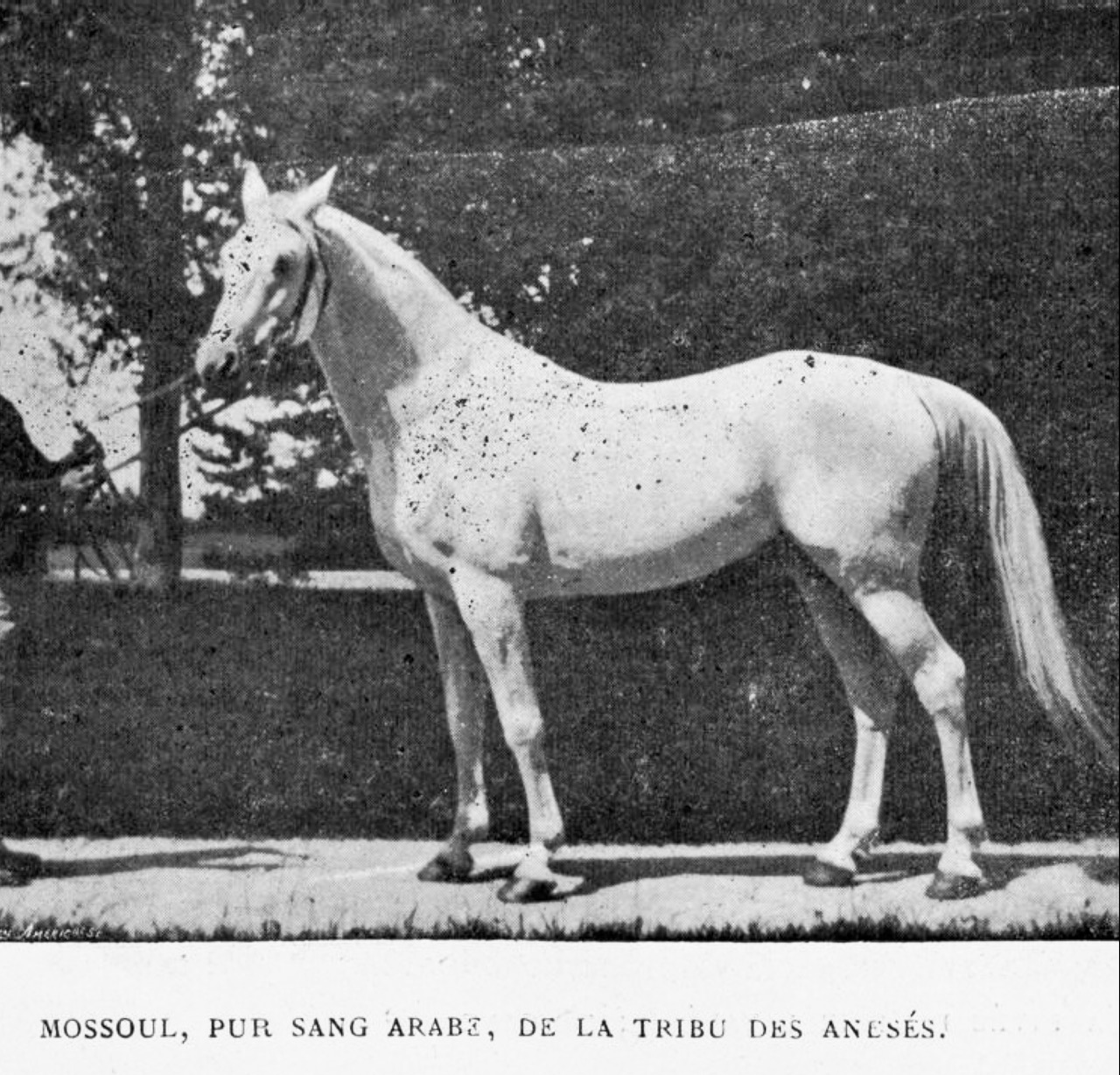
Mossoul, an ‘Anazah stallion, imported in 1892.
The article has a brief description of Mossoul, praising his forehand, chest and haunches, while casting a critical eye at his top line:
Mossoul, de la tribu des Anésés, importé en 1892 par M. Portalès, inspecteur général du 2e arrondissement; cet étalon, auquel on ne peut guère reprocher que son dessus, accuse une très grande noblesse: ses tissus sont très fins, et il est bien fait dans son avant-main, dans sa poitrine et ses hanches.
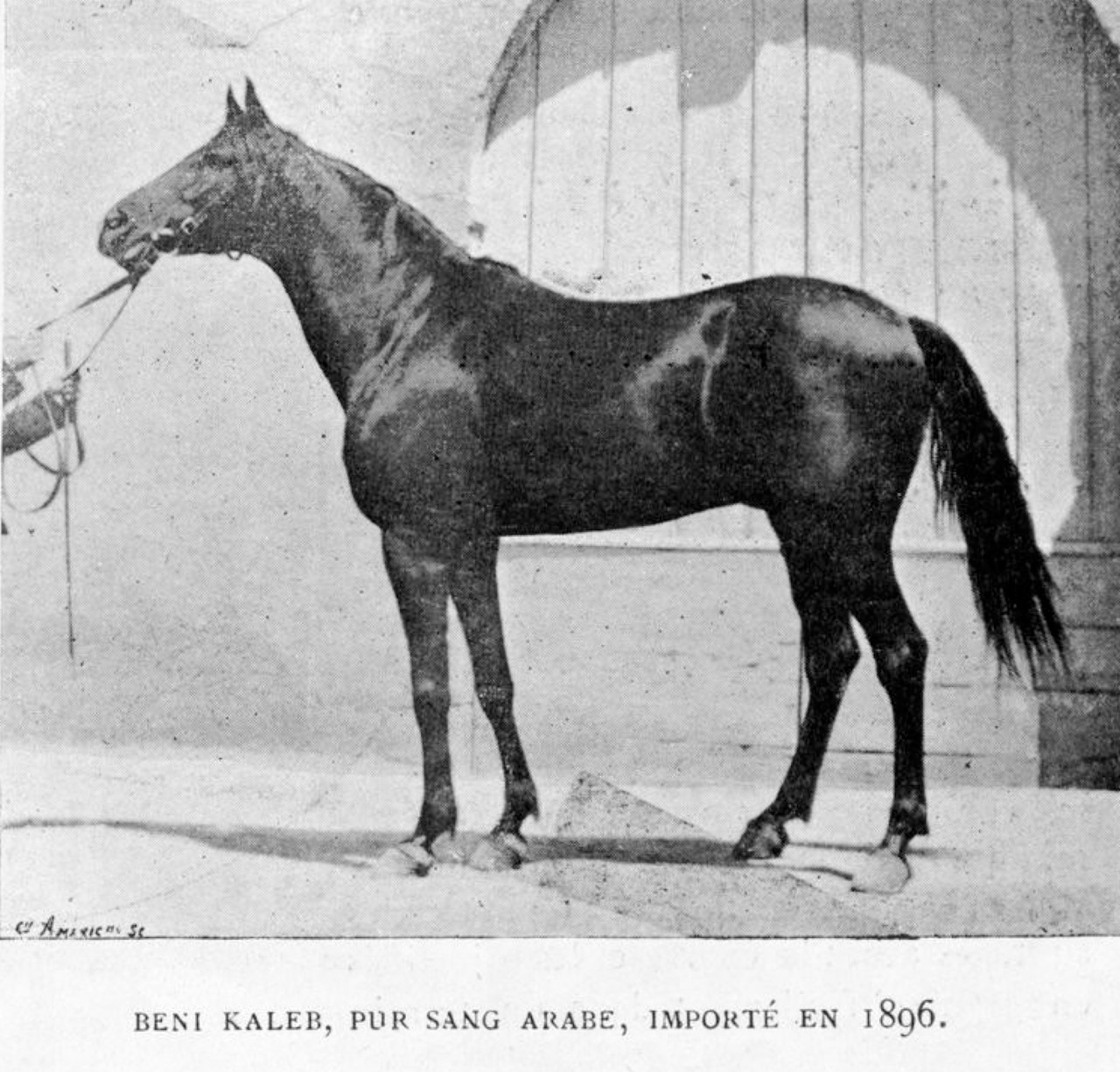
Beni Kaled, imported in 1896.
The article names three of the other stallions M. Portalès acquired during his 1896 trip: a black Ubayyan named Moudir, Sham and Mzérib. Moudir and Beni Kaled both stood at Pompadour.
In the description of Beni Kaled below, he is praised for his top line, the depth of his chest, his good legs and his remarkable movement, while his forehand shows the “oriental stamp”:
Dénotant bien le cachet oriental, dans son avant-main, avec un très bon dessus, de la profondeur de poitrine, des membres de bonne nature, Beni-Kaled remarquable en mouvement, s’affirme comme un reproducteur de premier ordre.
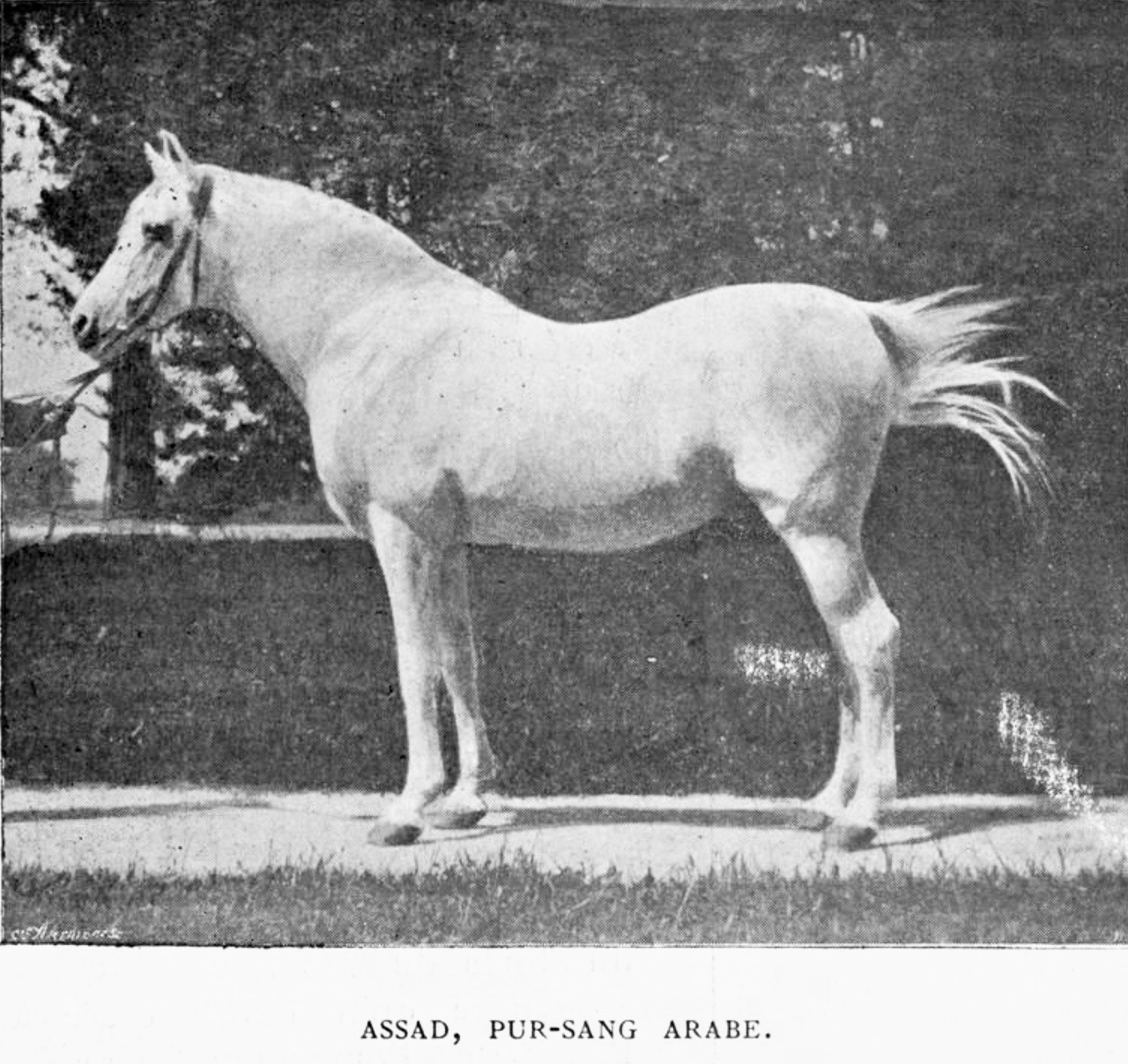
Assad, imported from Syria in 1887.
Lady Wentworth calls him “the best stallion” at Pompadour in 1900 and describes him as “really high-class” (p. 232 of the 1945 edition of The Authentic Arabian Horse and His Descendants). The 1894 illustrated catalogue of the Sociéte nationale des beaux-artes lists two paintings of him by the artist Henri-Louis Cordier, but unfortunately neither painting is among the artworks reproduced in the catalogue.
Three stallions that if we had them today could fix our modern day weedy weakling horses with their too feminine to even be a girl conformation. The thing is its my belief that the cradle countrys are still producing this kind of – i’ll state it clearly, improver stallion.
We certainly need this kind of horse today.
best
Bruce Peek
We don’t need them as they are around for sure. Why isn’t anybody breeding with available stallions like Rhoufi then instead of the usual asil inbreds m…rols?
because today everyone and their mother is a breeder, like everyone is a self-publisher, everyone is an author, everyone is an artist, etc. The quality of horses is a reflection of the quality of breeders.
The main problem for me is that most preservationist breeder of asil horses today, doesn’t compete in any discipline or show their horses. They solely rely on the asil status of their horses as marketing argument. There are some exceptions in endurance but doesn’t really proof the versatility of the asil Arabian (asils are often small size due to inbreeding and limited to rough terrain because of it).
As soon as you start competing, you will automatically start weeding out the inferior horses based upon their temperament, conformation and athletic ability.
But it’s not easy to do, it takes a lot more effort than breeding.
100 percent agree. Very clear-eyed point.
You told “(asils are often small size due to inbreeding and limited to rough terrain because of it).”
That’s true, both the asil and non-asil offspring of Mokhtar and Menjab are formidable in endurance on rough or heavy terrain. I also see this with my offspring from stallions imported from Syria.
Very nice. I think the authors meant (wrongly) “girth” by “poitrine” instead of “chest”. A chest can’t be deep but it can be broad
I’ve seen depth used for equine chests as well as breadth in some twentieth century texts, though these days I usually think of deep chests in connection with dogs and gastric dilatation volvulus. However, I concede that I haven’t got a clue what terms were typically used in conformation discussions of horses in French, and that ‘poitrine’ may be an error.
I also seem to recall that Mzeirib was a mare, and Moudir a Hamdani, both per the studbook. Just my recollection though.
The article may well be wrong on Moudir; as for Mzérib/Mzeirib, that one is on me for assuming that the horses listed were all stallions.
Here’s the quote in full:
“Parmi les Orientaux, il faut citer: Mossoul, de la tribu des Anésés, importé en 1892 par M. Portalès, inspecteur général du 2e arrondissement; cet étalon, auquel on ne peut guère reprocher que son dessus, accuse une très grande noblesse: ses tissus sont très fins, et il est bien fait dans son avant-main, dans sa poitrine et ses hanches. Il faut signaler,
achetés dans une 2e mission 1896-97 Beni-Kaled, Moudir, Sham, Mzérib. Les deux premiers ont été attachés au service de la jumenterie. Dénotant bien le cachet oriental, dans son avant-main, avec un très bon dessus, de la profondeur de poitrine, des membres de bonne nature, Beni-Kaled remarquable en mouvement, s’affirme comme un reproducteur de premier ordre.
“Moudir noir, de race obeyan, n’est peut-être pas aussi distingué que son camarade d’écurie, mais il a un dessus, des hanches et une poitrine qui défient toute critique: il rencontre bien avec les juments de pur-sang anglais, ayant de la taille et de l’étendue.”
There is definitely a Mzeirib mare that went to the Tiaret Stud in French Algeria in 1898. At the time, the Tiaret stud was still new and not fielding its own missions to the Orient. It was still relying on buying missions sent from France for its own supply. Her dam line still exists in France, likely asil.
https://www.allbreedpedigree.com/mzeirib
There is a nice photo of Assad posted on allbreed. Also his daughter Corozal (nice mare)
https://www.allbreedpedigree.com/corozal2
You find Assad, Moudir, Beni Kaled and others in the pedigree of Severine’s horses, specifically through Minos who was sent by Pompadour to Morocco, and from then to Quernin and her mother’s foundation mare Loubia Bint Breek
https://www.allbreedpedigree.com/minos13
https://www.allbreedpedigree.com/loubia+bint+breek
There is no doubt that anyone can be a breeder, but few are willing to take the trouble to go and see for example the production of rhoufi or to go to the tribes in Syria to see how some stallions transmit the irreplaceable blood of the desert. On the other hand, everyone knows how to do ” du copier/coller”