The horses of the elusive Ahmad Ibish
My research project about Syrian horse-racer Ahmad Ibish is progressing well, but I am not ready to share the results on this blog yet. Ibish, of Damascus, Syria, was on the top of my list of influential urban Middle Eastern horsemen of the twentieth century, along with Henri Pharaon of Beirut, Lebanon, Iskandar Qassis of Aleppo, Syria, and a few others. However, I can say a couple things about the horses he was associated with, at different times. I could find four of these, all stallions.
The first, and perhaps most famous here in the US, was Aiglon. Aiglon was a Saqlawi Jadran imported by Ibish to Egypt for racing, around 1920, according to the export document for his daughter, *Exochorda, attested to by Dr. Branch, the Director of the Royal Agricultural Society of Egypt. *Exochorda, named after the ship that brought her to the USA, is of course best known as the dam of Sirecho.
The second was El Sbaa. El Sbaa, a chestnut, was bought from Ahmad Ibish by a French government mission led by Madron and Denis at the Cairo Heliopolis racetrack in 1925, and sent to the French Stud of Pompadour where he was used as a stallion. De Madron related the circumstances around his purchase in his bool. El Sbaa was recorded as a Ma’naghi Sbayli, but there is an additional paper attached to his file at Pompadour, which clarifies that according to the leader of the Hadidiyeen Bedouin tribe, Nawaf al-Salih, his strain was actually Ju’aitni. I wrote about him extensively, here.
The third was a bay stallion named Ibisch, born in 1902. I don’t know his strain. All I know is the French bought from Ahmad Ibisch, and took him to Tunisia, where they used him at their Etablissements Hippiques d’Afrique du Nord. Ibisch is still represented in modern pedigrees, since the two influential French bred stallion of Algerian/Tunisian lines Saadi and Ourki (both by Ourour out of Oureah, by Ghalbane and Fantazia by Vizir, who was out of Omphale, who was by Mossoul, by Ibisch).
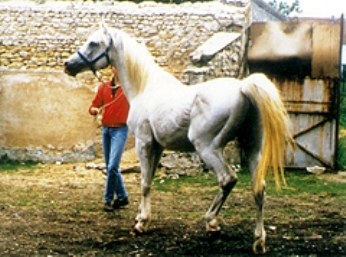
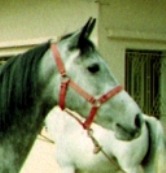
The fourth was a chestnut stallion, whose racing name was lost, but who remains forever influential as the sire of Krush Halba, a Lebanese-bred stallion exported to Turkey where he founded an important sire line, in addition to being the foundation stallion of the now defunct Lebanese asil breeding program (below is headshot of my own Al-Tuwayssah, the last suviving mare of the program. She has two close lines to Krush Halba). The hujjah of Krush Halba is featured on the WAHO website, from which comes the following quote:
“His father (sire of the Krush) is the golden chestnut horse with blaze and markings on the left legs, he is the Saglawi Shaifi of the breeding of Ibn Ghobosh from the Al Fidaan tribe, that was purchased by Solaiman Ojel from the Fidaan and sold by him to the famous Ahmad Afandi Ebesh at the price of one hundred and sixty Ottoman Lira. The above mentioned sold him to Egypt at the price of five hundred English Lira and after that he won two races.”
While this Saqlawi Shaifi will probably remain unnamed for a long time, his story provides with a number of interesting insights as to the supply chain that ends with Ahmad Ibish. From the above quote, and the information available about the other horses, we learn that :
a) Ahmad Ibish used to deal with Sulayman Ujayl, the scion of a family of Syrian horsemerchants from Hims in Central Syria, who used to buy their horses from the ‘Anazah tribes whose summer pastures were near Hims.
b) Ibish did not hesitate to acquire mature horses who already had an opportunity to be used as stallions before being raced.
c) Ibisch bought horses straight from the desert source: El Sbaa came from the Hadidiyeen and the Saqlawi Shaifi came from Sba’ah.
d) Ibisch used to pay large sums for his horses: One Hundred and Sixty Ottoman Liras. (Will need to see how large this amount was for the time).
e) Ibisch used to act as a horse-merchant as well. He bought horses for racing, but he also sold them to racehorse owners, presumably with a profit margin. Not sure how much the conversation rate between Ottoman Liras and English liras was at the time.
f) Ibisch, a native of Damascus, Syria, was active in both Syria and Egypt.
I am anxiously awaiting what you have found and what you write. It seems that anyone associated with horse racing in that part of the world (and this one for the most part, I suppose) is always considered to be “shady” of character. And usually a cad when it comes to telling the truth… no matter where they came from!
Ibish is coming out really clean so far..
Wow, what a coincidence! To come late better than never. First time I come across this article about my grand father, the reason is we usually don’t write our family name thus: Ibisch, even though it is the right form in Turkish. The rest of my family write it Ibish, Ibesh or in French: Ibeche. While I’m the only one how use the form (Ibesch) due to my higher studies in Germany. I am BTW a historian and would love to know more about sources of this article. I believe Baron Max von Oppenheim must be the main source of info? Regards, Ahmed
Hello, Ahmad,
I am glad you found us. I am happier we found you. I know at least a dozen horse breeding people who would be very eager to talk to you. Perhaps we can correspond.
No, Oppenheim is not the source of this information. It actually comes from horse certificates, studbooks and letters from at least six different countries (france, tunisia, turkey, egypt, the USA and lebanon)
Ibish is mentioned numerous times in the Race Calendars for the Egyptian Jockey Club during the early part of the twentieth century. I will have to dig them out in order to offer exact data, however, I do recall that Ibish was also listed as a trainer as well as an owner in those records. Also, if I’m not mistaken, he was awarded some sort of commendation for exceptional performance..either for the race wins of the horses he owned or for the horses he trained. I will report back when I have located the exact information.
Hello Edouard, Hello Caryn,
It’s a great pleasure to read your reply, however sorry I was late again to respond, I left my country Lebanon and took back the same route my grand father has taken before from Turkey, but I mean the other way around. About Oppenheim I know for sure he was a friend of my grand father’s, also what Caryn mentions is quite right, Ahmed Ibish used frequently to reside in Alexandria for this purpose in the first two decades of the 20th. Century. His legacy was unfortunately lost, except some old photos of him and his horses I still keep in Damascus. I will be glad to correspond with you. My email is: a.ibesch@hotmail.com
Best,
Ahmed
if one day you get hold of the horses pictures please share them with us
Yes, please! There are some of us who would be most interested in seeing them, and learning more about his program.
Right, it’s an easy task. I am traveling to Damascus in two days, I will copy some pics and post them. Most of these photos depict racing thoroughbred horses I believe, more than Arab ones. Sadly, I’ve never known my grand father, he passed away 21 years before my birth.
Hi Edouard, I’m back, I’ve got a few pics, where do I exactly post them?
you send them to me at ealdahdah@hotmail.com