A two hundred year overview of the Mlayhan strain
I am now reading a 2002 French-language edition of Count Waclav S. Rzewuski’s manuscript “Sur les Chevaux Orientaux et Provenants [sic] des Races Orientales“. Rzewuski wrote his book sometime after his stay in Arabia from 1818 to 1821, where he lived among the Arabs and bought up to 100 stallions and 35 mares for European royalty and nobility, including for his own stud. One mare he bought for himself is “Mliha”. Below, in italics are some passages where Mliha is mentioned, followed by my own comments:
“Mohammed pacha, surnommé Gensh, emir des Metoualis [sic] avait une jument de la race Koheyl Adjouz surnommée Mliha […] Le soldat fut pris avec sa belle Mliha par les Fédaanes, chez qui je la vis et l’achetai.” Here we learn of the mare’s strain: Kuhaylan ‘Ajuz (or a strain derived from it); her name, “Mliha”, which could also be her strain — Mlihan/Mlayhan/Meleyhan. We also learn that Rzewuski got her from the Fad’aan ‘Anazah tribe.
“Mliha est la fameuse jument de Mohammed pacha Gensch, émir des Mewalis”. Here we learn of the mare’s original owner, Muhammad al-Kanj (“Gensh”), Amir of the Mawali Bedouin tribe. Unlike all other tribes, which have Shaykhs as leaders, the Mawali are led by an Amir, a Prince. Today the Amir of the Mawali is Fayad Muhammad al-Kanj, of the house of Abu Rishah.
“Ma fameuse et belle jument Nejdieh Kocheileh el-Bedawieh el-Anazeh Kocheileh Adjouz Mliha, alezane“. Nothing new here, other than the chestnut color. The rest is the pompous title Rzewuski gives all his other desert-bred Kuhaylans from the Najd “race”: Nejdieh Kocheileh el-Bedawieh.
The connection of “Mliha” with the Mawali is illuminating, because the Mlayhan is one of the house strains of this tribe. This connection leads me to believe that Mliha is actually the mare’s strain. George P. Tabet’s 1937 “Les noms de famille des chevaux arabes” cites the Mlayhan strain as being specific to the Mawali, and mentions one branch: Mlayhan Shahm Rass.
More generally, the fact that the leading house of the Mawali originate from the Tai tribe explains both the current presence of the strain with the Tai as well as its antiquity with them. The Tai clan of al-Nahhab in Northeastern Syria still owns the strain, registered in the Syrian Studbook as Kuhaylah Mlayhiyah. They claim to have brought it with them from Najd a long time ago, through Iraq.
Lady Anne mentioned the strain with the Northern Shammar tribe, with which the Tai of Northeastern Syria were closely affiliated. She also mentioned it among the tribes of Southwestern Iran (today’s Khuzestan). It still exists there.
Mary Gharagozlu’s Iran Asil Studbook of Khuzestan (1975) records that a 1911 white Meleihe (local spelling) stallion (sire: Meleihe dam: Meleihieh) was given by Ghassem Ali Zargani (G.A.Z.) of the Jassemi clan of the Bedouin tribe of Kaab to Sardar Mohtashem Bakhtiar, father of Mary’s husband Majid Bakhtiar. It further records that the 1924 white stallion Meleihe Sanhir (sire: Meleihe dam: Meleihieh) was imported from Najd to Khuzestan and became a stud from 1929 to 1933 for his owner Sardar Mohtashem Bakhtiar.
I am going to draw a figure or map of how I believe this ancient strain originated and spread, once I am done doing a bit more fact checking.
Below, the lovely Sotoudeh, a 1998 Iranian Asil Meleihieh of that Ghassem Ali Zargani strain. Photo courtesy of Jens Sannek, who just like me, is awed by this strain.
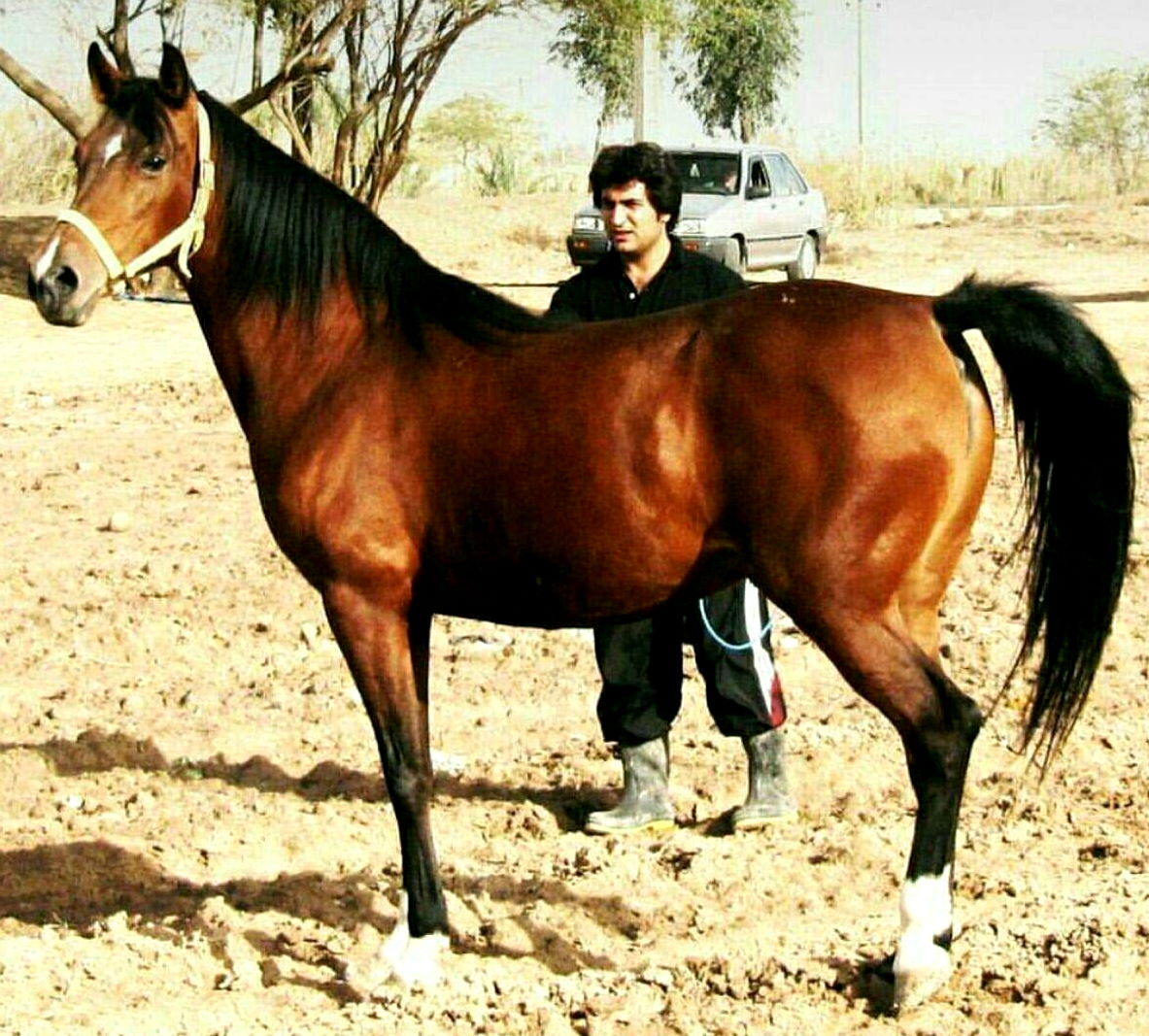
Impeccable coupling- fabulous hindquarters triangle. Maybe could use a bit more canon bone- hard to tell without being able to actually tape measure it- so.. I bet he was a wonderful mover!
best
Bruce Peek
Rzewuski’s manuscript is an amazing work. Together with Carlo Guarmani’s “Journey to Najd” it’s a must read.
Agreed. Not easy to disentangle truth from fiction though
I think they’re super interesting because they date from / during the migration to the north of the Najd bedu while the Blunts travelled when most where already in the northern deserts.
I have read them a long time ago but there is a § in either Rzewuski or Guarmani work where is described that the bedu were now selling their mares out of fear of Saud (that he would steal the bedu’s mare or would press the bedu into service to fight for him).
Both make distinction between the Najd Arabian horse and the northern (while during the Blunts ventures, the Najd horse had either migrated to northern deserts or was unreachable behind Sauds borders).
Both mention the need of infuse of najd blood to keep the type and characteristics (like the Russian and Polish state studs have done with first desert blood and later Egyptian stallions).
I haven’t read Rzewuski’s ‘Sur les chevaux orientaux’ yet, and need to check Guarmani, but Burckhardt 1830:249 provides (additional) testimony on the sale of horses to avoid military service under Sa’ud:
“During the government of the Wahaby chief, horses became more scarce every year among his Arabs. They were sold by their owners to foreign purchasers, who took them to Yemen, Syria, and Basra; from which last-mentioned place the Indian market was supplied with Arabian horses, because they feared that Saoud or his successor might have seized them; for it had become the custom, upon any slight pretext of disobedience or unlawful conduct, to confiscate a Bedouin’s mare as a forfeit to the public treasury. The possession of a mare, besides, imposed an obligation on the Bedouin of being in constant readiness to attend his chief during his wars; therefore many Arabs preferred the alternative of being altogether without horses.”
Anyone would be proud to own a mare like that! What a beauty!
right? she is gorgeous