Belka, Great Endurance Test, 1921
The photo below, by Sport and Press General Agency, comes from the article, ‘Arab Horse Society’s Endurance Test’, printed in the 7 October 1921 edition of the Live Stock Journal,
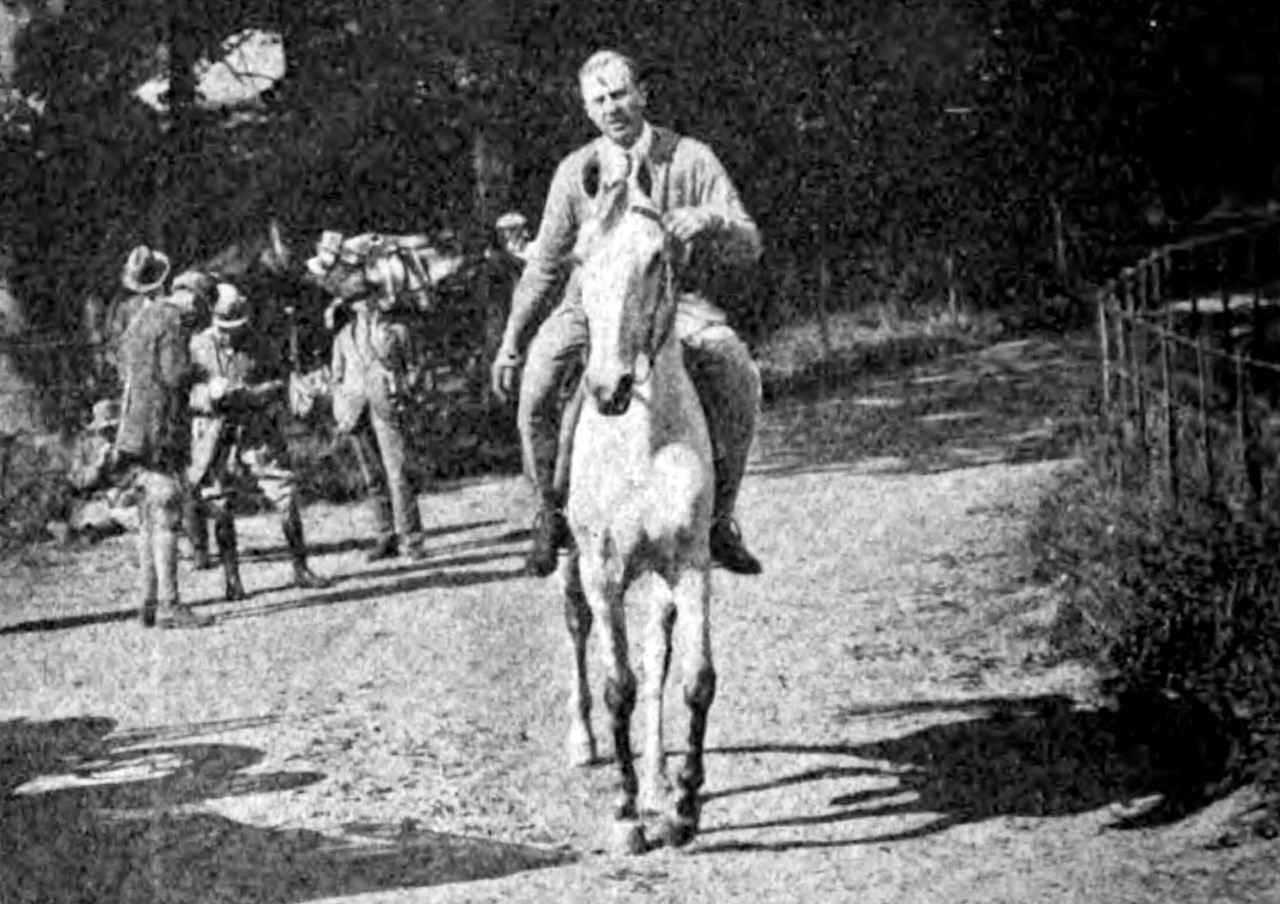
The original caption reads: Belka, Mr. H. V. M. Clark up, in the concluding stages of the Arab Horse Endurance Test.
This was the second of the three endurance tests held by the Arab Horse Society between 1920 and 1922. The first and the third were won by Shahzada (later exported to Australia), while the Crabbet-bred Belka won the 1921 ride, having finished third in the inaugural 1920 ride.
The 1920 ride had been 250 miles, but in 1921 the distance was increased to 300 miles, with the horses covering 60 miles a day. Nine horses entered, all of them carrying 13 stone, or 182 lb, at the weigh-in.
Six of the entrants were purebred Arabs. The article gives their names, ages, weight, height, owners and riders as below:
Mr. H. V. M. Clark’s mare Belka by Rijm out of Bereyda, 9 years, 798 lb. , 14 h. 3 in. (owner).
Mr. L. Edmunds’s stallion Shahzada by Mootrub out of Ruth Kezia, 9 years, 777 lb., 15 hands (Mr. Morgan D. Blair).
Mrs. F. G. Atkinson’s stallion Chandi, desert bred, 10 years, 700 lb., 14 h. 1 in. (Mr. R. S. Summerhays).
Mr. S. G. Hough’s mare Riz by Razaz out of Rijma, 5 years, 763 lb., 14 h. 3 in. (Capt. A. D. Hough).
Mr. S. G. Hough’s gelding Robin by Rohan out of Merjana, 13 years, 746 lb. , 14 h. 3 in. (Mr. C. W. Hough).
The course began and ended at Lewes, running across the Sussex Downs to a turning point a little distance beyond Amberley. It was undulating, with some stiff climbs and steep descents:
Mostly along the crest of the Downs there was also some eight or nine miles of road work, and the steep gradients increased the severity of the test. Starting almost at river level at Lewes, the Downs were reached at a height of 250 ft., from which there was a switchback course to 813 ft. at Ditchling Beacon, a fall to 200 ft. at Pycombe and a rise to 655 ft. at Saddlescombe. Then came a drop to 400 ft. before the highest point of the course was reached, 859 ft. at Devil’s Dyke, and the lowest point was 50 ft. at Bramber. Chanctonbury Ring, one of the points of the course, stands at 783 ft., and there is a fall to 200 ft. at Muntham Court before 697 ft. is reached at Amberley Mount, the turning-point being a little further on.
While nine horses started only Belka and Shahzada finished, due to heat and hard ground.
The weather could not have been more beautiful or more inimical to the test. There was generally a fog or a rime frost in the early hours of the morning, but practically the whole of each day’s journey was conducted beneath a cloudless sky and a blazing mid-summer sun, with scarcely a breeze to temper the great heat, even on the high Downs. The usual carpet of the Downs had turned to adamant, and the plough was as dry as chips. It is not to be wondered at, then, that after the second day, when Belka and Shahzada had established a pronounced lead, several of the owners decided not to unduly press their animals, but to retire from the contest.
Chandi, the smallest of the entrants, completed the third day, which seems to have been the hardest on the horses, before his owner withdrew him.
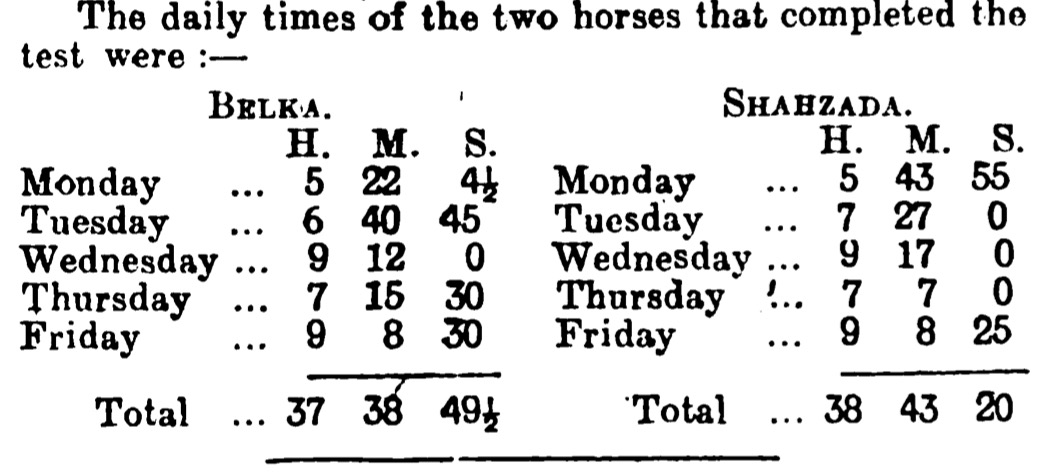
The daily times for Belka and Shahzada.
The article notes:
[I]t must not be imagined that these were the pick of the Arab horses in England, but merely the property of a few keen breeders who think these gallant little animals capable of something better than the mere collection of showyard ribbons, that of carrying heavy weights over long distances. A little practice is worth a deal of theory, and animals that can point to something done will benefit a breed far more than those whose fame rests solely on the victories of the show ring. That is, unless the breed is to rank only among the “pets,” and be classed with prize rabbits and Pekingese dogs.
Belka went on to compete in the 1922 test, but Clark withdrew her partway through due to illness.
Belka produced a handful of foals at Clark’s Courthouse Stud. Her grandson Bahram (Sainfoin x Betina) was the 1954 U.K. Supreme Male Champion, while his half-brother Boaz (Joseph x Betina) won the South African 1951 Purebred Champion Stallion class. While Belka no longer has asil tail female descendants, she is still found in asil horses through Rosina, a granddaughter of Belka’s son Bendigo (by the imported Atesh); exported to South Africa as a youngster, Rosina has asil descendants in South Africa and Namibia. One of them, the 2008 chestnut gelding Abhaki Adios Amego (Skarabee Zaafir x Kamarie Yosra), finished third in the lightweight category in the 2016 Fauresmith National Endurance ride, a 204 km ride (126 ¾ miles) which takes place over three days. Carrying 65 kg or 143 lb, his total time for the distance was 8 hours 25 minutes 29.91 seconds, with an average speed of 24.2 km per hour (15 miles per hour).
Barghi Ibn Dirri, the strain owner, on Belka’s not so distant female ancestor: https://daughterofthewind.org/she-outraced-all-of-them-by-far/
Speed and stamina in that female line, clearly.
Enjoyed the read. Those lines do intrigue me. If only there were 3 of me and time stood still to put the blood of those ancestors here to test!
The “She-outraced-all-of-them-by-far” article still maintains that Meshura no longer has asil descendants, but Laszlo Kiraly’s 1994 mare Saraly El Shahin and 2015 daughter, Salome Hamdaniya do trace to Meshura.
Have either of these bred on in asil lines?
They both died.. without descendants. Salome got scared and jumped off a cliff in Italy. Her dam died of old age
And that was an absolute tragedy!