Bojanowski and Borowiak on Branicki‑bred horses in the imperial Ottoman stables
The Polish author Stefan Bojanowski writes in his 1906 book, Sylwetki koni orientalnych i ich hodowców, that in 1864 Sultan Abdülaziz purchased 92 horses from the Białacerkiew estates of the Branicki family, and incorporated them into his stud (p. 73):
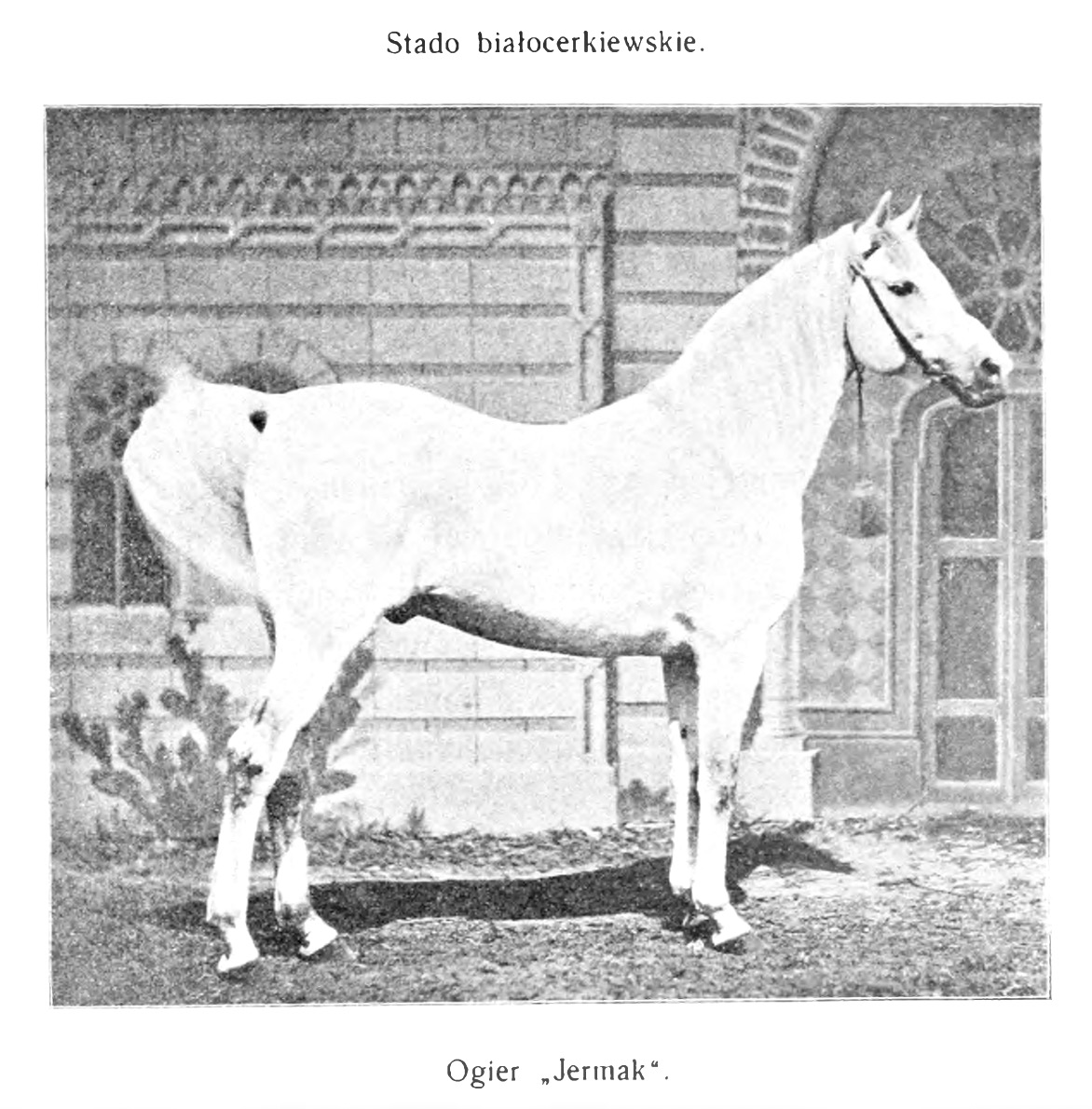
Bez przesady powiedzieć można, że obok „sanguszkowskich“ koni — konie „białocerkiewskie“ wychowywane na bujnych stepach żyznej Ukrainy w stadach hr. Branickich, były w Europie do niedawna najbardziej poszukiwanymi końmi krwi wschodniej, czego dowodzi fakt, że Sułtan Abdul-Azis, chcąc założyć dla siebie pod Konstantynopolem prywatne stado silnych i rosłych, a przytem szlachetnych oryentalnych koni, wysłał w r. 1864 na Ukrainę do stad białocerkiewskich swych koniuszych i weterynarza, którzy zakupili: 2 stadne ogiery, „Jarzmę“ i Inaka“, obydwa po wywodowym Indyaninie, 8 koni wierzchowych, 6 zaprzęgowych, 48 matek, 17 trzyletnich, 21 dwuletnich i 4 rocznych klaczek. Jeżeli odliczymy 14 koni wierzchowych i powozowych, które jako konie użytkowe nie poszły do stada, to pozostała jeszcze poważna liczba 92 koni, które hr. Braniccy oddali jako cenny materyał hodowlany do „sułtańskiego stada“,—a to wystawiło Białocerkwi bezsprzecznie najchlubniejsze świadectwo naszej polskiej hodowli.
The horses bought for breeding were two stallions, Jarzmo and Inak, both sons of Indjanin, 48 broodmares, 17 three‑year‑olds, 21 two‑year‑olds and four yearling fillies. An additional 14 horses were bought as saddle and harness horses, and were not included in the breeding herd.
Borowiak also mentions the Sultan’s purchase in his 1914 dissertation, Die arabische und anglo-arabische Pferdezucht der Grafen Branicki in Białocerkiew, when discussing Indjanin (pp. 22f.):
Indjanin, ein Araber von hohem Adel und großen Vorzügen, der 7 Jahre lang segensreich für das Gestüt wirkte. Er bewährte sich in der Nachzucht so vorzüglich und verbreitete den guten Ruf der ,,Branickischen Pferde” weit über die Grenzen der Ukraine, so daß Bjalocerkiew als die wertvollste Zuchtstätte orientalischen Blutes dem Sultan Abdul-Azis erschien, und würdig, die Grundlage zu einer neuen Zucht orientalischer Pferde im Kaiserlichen Marstall zu Konstantinopel zu bilden. Die türkische Ankaufskommission wählte aus dem Branickischen Gestüt 92 Pferde verschiedenen Geschlechts und Alters aus. Die beiden Söhne des Indjanin: Jarzmo und Inak wurden die Begründer der kaiserlichen Zucht in Konstantinopel. Sie hatten sich beide bereits im heimatlichen Stalle als tüchtige Vaterpferde erwiesen. Unter der angekauften Jugend befanden sich zahlreiche Kinder von ihnen. Diese Ankaufskommission des Sultans stellt der Branickischen Pferdezucht ein glänzendes Zeugnis aus. ( 1864.)
Borowiak adds that many of the youngstock purchased were by Jarzmo and Inak.
Both Bojanowski and Borowiak state that the Branicki horses were foundation horses for the stud of Abdülaziz, as does Antoni Barański, in his 1883 Chów Koni, though he states that the Sultan bought just sixteen horses (p. 177).
I have not yet found any primary sources from the 1860s, such as newspaper articles, which mention the sale of the Branicki horses to the Sultan. I presume that the information comes from the Branicki herdbooks, which Wilfrid Blunt consulted during his 1875 visit to Ukraine.
In his entry dated 20 September, Blunt describes his impressions of the Uzin stud and its horses, belonging to Count Ksawery Branicki (pp. 223f.):
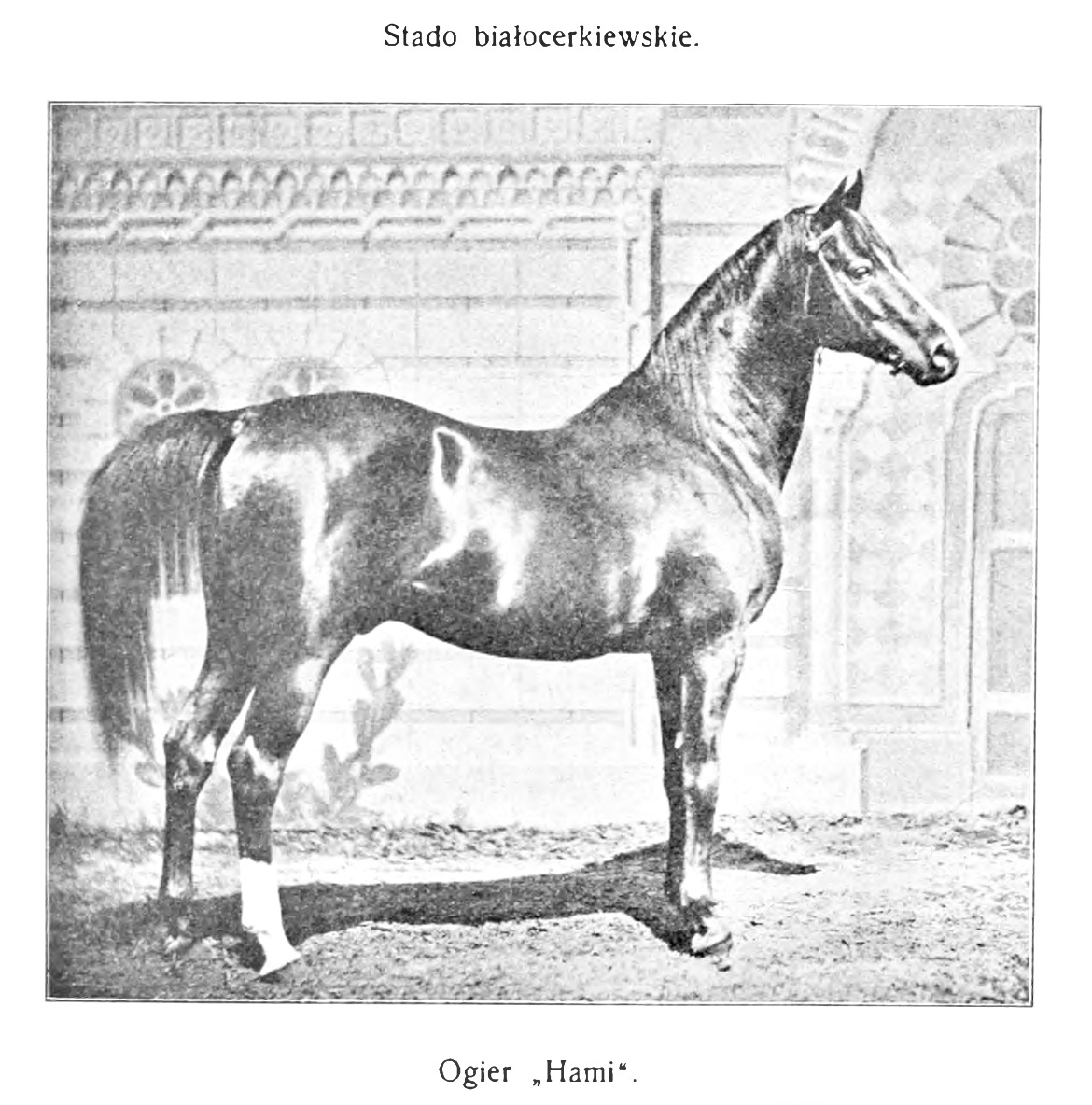
The history of the stud, of which I have looked over the books, seems to begin authentically in 1813, though Sapieha claims for it forty years more antiquity. It can hardly be called a pure Arab stud, as the stallions then imported stand entered as Turk, Turcoman, Anatolian, Persian, Arab, and even in 1828 English, while the mares are equally mixed. It is clear that they have run too much after size; and at Uzin the type is nearly lost. Оссаsionally, however, they produce a first-class horse, and I saw two such, ‘Hamat’ and ‘Haman,’ a bay and a chestnut, of great beauty and ideal action, though 15.2 or more in height. The latter especially is a nearly perfect specimen, and will be retained to breed from. The mares are far inferior in looks to the Sanguscko mares, having coarse heads, long backs, and long legs. They carry their tails, however, generally well. One cannot avoid the conviction about them that they are of mixed origin. I only saw one mare, ‘Tamisa,’ one would have supposed to be an Arab. They are breeding now largely from an English thorough-bred, which gives more saleable stock. They have, however,
a very beautiful imported Arab stallion, ‘Heyan,’ of which they are proud—a dark, full chestnut, compact, strong, and of the highest quality. I should judge him to be a horse from Nejd, as he is not quite of the Anazeh type. But they know no more about him than that he was brought to Warsaw by a dealer. I strongly advised his use for their stud.
— 1919. My Diaries: Being a personal narrative of events. 1888‑1914. Part One. 1888 to 1900.
Blunt’s views on the history of the stud and the mixed breeding of the horses agrees with both Bojanowski and Borowiak’s accounts.
Bojanowski dates the founding of the Branicki herd to 1778, when Hetman Franciszek Ksawery Branicki established the Szamrajówca stud. He had been gifted the Białacerkiew estates by Stanisław II Augustus in 1774; twenty years later, his portrait was hanged for treason for his pro‑Russian politics, along with the portraits of Seweryn Rzewuski (father of Wacław Rzewuski, the orientalist and Arab horse breeder) and Stanisław Szczęsny Potocki. Potocki owned a stud in what is now Tulchyn, in western Ukraine, and supplied two stallions and thirty mares of unknown ancestry to Franciszek Branicki (p. 74):
Oryentalne stada hr. Branickich, dawniej ogromne, a dzisiaj bardzo zmniejszone, znajdujące się obecnie w Szamrajówce, Uzinie i Janiszówce, — powstały z dawnego, szamrajowieckiego stada, które w r. 1778 założył hetman W. K. Franciszek Ksawery Branicki przez nabycie 2 reproduktorów wysokiej krwi wschodniej i 30 prześlicznych klaczy, wprawdzie nieudowodnionego pochodzenia, ale „prudenter et honeste“ wybranych w renomowanem niegdyś „tulczyriskiem” stadzie Szczęsnego Potockiego, wojewody kijowskiego. Niektóre z tych klaczy były ponoś po znanym a doskonałym kasztanowatym oryentalnym ogierze „Jemen“, który poprzednio był w Krystynopolu koniem wierzchowym Franciszka Salezego Potockiego, wojewody ruskiego, a następnie dostał się do Tulczyna na reproduktora.
Some of the mares were sired by the chestnut stallion Jemen, the riding horse of Potocki’s father. Bojanowski calls him an “oriental” horse, which may mean he was imported from the Middle East.
Bojanowski says that Branicki’s two foundation stallions were of “high Eastern blood”.
Borowiak states that “[d]aneben wurden auch aus den in der Starostei vorhandenen ,,polnischen Pferden” geeignete Mutterstuten von möglichst orientalischem Typus im Gestüt eingestellt” (p. 4), i.e. Branicki added local mares of “oriental type” to the original Potocki horses. He also says that Branciki wished to produce useful, versatile horses for riding and driving “durch stetige Zuführung orientalischen Blutes Araber, Perser, Turkmenen” (ibid.), i.e. through continued crossing with Arabian, Persian and Turkmen horses. There is no mention of an intention to breed Arab horses.
Bojanowski and Borowiak both comment on a lack of reliable records for the Branicki horse breeding operation in the eighteenth century; Bojanowski says that the stud books were not kept carefully until 1803 (p. 76), while Borowiak says the first Branicki stud book was introduced in 1812 (p. 7).
The stallions used at the Branicki studs up to the 1860s include imported desertbred Arabians, Persian horses, Turkmens, Turkish horses, homebreds, and stallions with no origin given (Bojanowski pp. 76‑81, Borowiak pp. 7‑26). One stallion, the grey Sak-Ban, was purchased in 1861, from the Viceroy of Egypt; given the name, the colour and the timing, this may have been a horse that came from the final dispersal of Abbas Pasha’s stud, either a maternal half-brother to El Delemi named Sakban, or his son. Neither Bojanowski nor Borowiak mention Blunt’s English stallion from 1828, but Borowiak (p. 20) discusses a stallion Machmoud, foaled in Szamrajówka in 1842, who is recorded as English in the Branicki stud book and registered in the Russian Stud Book for Thoroughbreds (Book 3, Volume 1, p. 552), but is by Soltan, a stallion described as Arabian. Borowiak suggests this was due to the fact that Arabian horses could be registered in the General Stud Book, and that Machmoud was an Arabian. Bojanowski is silent on the existence of this horse.
The evidence above suggests that Arabian horses sourced from the imperial Ottoman stud from the mid-1860s on may not have been entirely Arabian, if they traced to the Branicki imports. However, without the details of the individual Branicki horses purchased – whether sixteen or ninety-two – it is impossible to know how many of them had non-Arabian ancestry. Ottoman records should also be consulted, to both clear up the inconsistencies in the three Polish sources re the number of horses purchased, as well as to gain a more complete picture of Ottoman horse breeding at the imperial studs.
Aha, you found confirmation on that info that the sultan’s stud included Polish “Arabians.
I have read somewhere that 3 or 4 horses coming from the Sultan’s stud were included in Attaturc’s new statestuds which were for the rest of pure desert horses. To find out of the Turkish bloodlines are asil, it might be easier to find out if indeed there were 3 or 4 Sultan horses in their foundation horses for the state studs and if they bred on. And if they bred on, it is worth finding out more about them. Maybe only very few where still asil and reason why only 3 or 4 were included in the state studss.
If you could remember where that “somewhere” was. Also here is a useful link on the list of foundation horses included in the Turkish studbook:
http://www.waho.org/blog/wp-content/uploads/StudBooks/WAHO-INVESTIGATION-AND-INSPECTION-REPORT-TURKISH-ARABIAN-STUDBOOK-1997.pdf
The table is self explanatory.
I think it was in your own article here 🙂
And there were 8, not 4 (have 4 in my mind, maybe picked it up elsewhere as well.
https://daughterofthewind.org/the-arabian-horses-of-turkey/
In the WAHO it says 7 (“which were originally imported” … from where?)
It also reads “All the foundation horses as shown in Appendix A have either a ‘hojja’, which is an Arabic hand-written, sworn statement of authentication, sometimes containing a pedigree certified by thumb prints, seals and stamps, or in the case of the horses from within Turkey, sworn statements of origin and strain from the owner duly certified and authenticated by the village headman and provincial governor responsible for horse registrations. From their strains it is evident that all come from the most favoured ‘desert-bred’ origins.”
The palace horses are indicated in the list as “Palace/D.B.” so offspring of desertbreds? Even the hungarian import seems to be asil.
Hard to say then down to the specific horse which ones were truly Asil.. But we fo have the photographic evidence of our current day horse breeding groups. For example one of the families at the barn i board at recently bought a cmk mare- chesnut and chrome- who happens to have one of the best couplings i’ve ever seen. Predominently Davenport and Crabbet- she also has not the largest withers you’ve ever looked at. One of the kids in the family has an outcrossed Naborr/ Bask gelding with a long neck and nicer shoulder- but weaker lumbo sacral. Visual evidence of the ancestral breeding patterns which formed our current day breeding groups.
Also just to set the cat among the pigeons it seems to me the cmks actually have way better collected, basculed movement than any other breeding group that has been established in America including high dollar warmbloods and Andalusions..
best
I agree with you there, Bruce. I’m prejudiced, of course, but I think the Davenports are, as a group, especially strong in balance and in coupling.
I, too, am prejudiced. I believe English breeders were connected to dressage earlier than American breeders, thus breeding for raised backs.