Photos shared here by kind permission of Oliver Seitz.
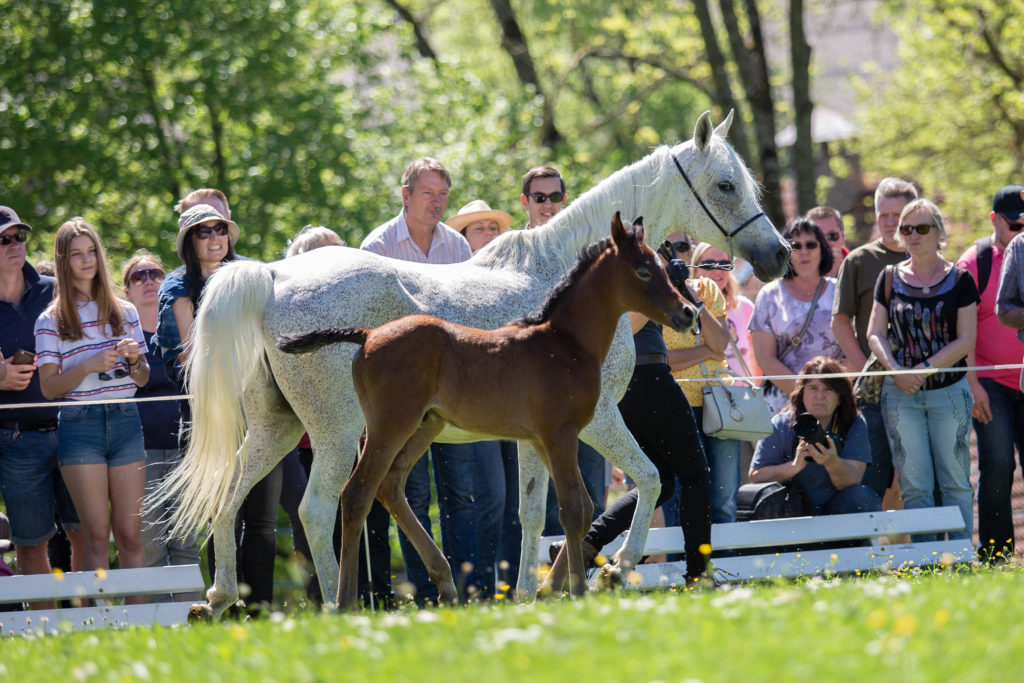
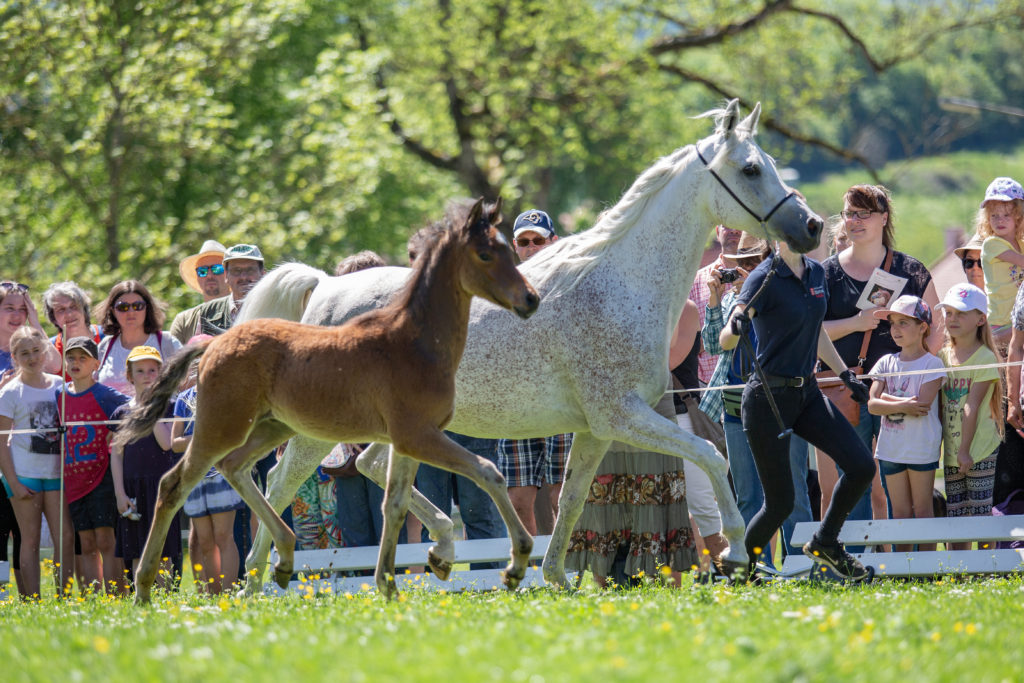
Sabiha (NK Bolbol x Sarina) with her foal, WM Shaqueel, by NaoufilSabiha (NK Bolbol x Sarina)WM Sahaabah (KP Maryoom x Sadaawi) with her foal, WM Schalal, by NaoufilWM Sahaabah and WM SchalalSarafine (Insh Alla x Sarina) with her colt, WM Shakur, by MusabWM Shakur (Musab x Sarafine)
9 thoughts on “Murana I mares and foals at Marbach’s Day of the Arabian Horse 2019”
I wonder what the archives of the port of Trieste can yield about Murana I and the activities of baron Von Fechtig.
Lyman, her strain is not known, though Freiherr von Hügel said she was a Saqlawiyah Jadraniyah. Von Fechtig, though, did import horses from the desert, including Tifle, Tajar and Bairactar.
Edouard, that would be interesting – there must surely be ships’ manifests somewhere which record the arrival of horses from Syria for von Fechtig. I am hopeful that Ishtar can be found that way in the UK, but that will have to wait for a research trip to England.
Kate,
I am not familiar with these names. Who was Freiherr von Hügel and what was his relationship to the person that purchased Murana I from a Bedouin?
Thanks,
Lyman
Ferdinand von Fechtig was a Hungarian nobleman, whose father-in-law, Anton Count Cassis-Faraone, had been born in Damascus, and lived in Trieste, where he had business ties with the Levant. Von Fechtig apparently exploited these connections to acquire Arab horses for European studs; Bairactar, Tajar and Murana, for instance, found their way to Wilhelm I of Württemberg’s private stud at Weil. Von Fechtig was also a breeder of Arabians, until 1850, when he dispersed his stud.
Julius von Hügel was Wilhelm I’s equerry and the director of Weil from 1852 to 1871. He visited Egypt at least twice that I know of, and brought back horses from Abbas Pasha’s stud. I have his 1861 book, where he says of von Fechtig and Murana:
“Schon im Jahre 1814 erkauften Seine Majesta?t zwei arabische Hengste, Emir und Mameluk, von einem Baron Fechtig, welcher spa?ter selbst ein edles arabisches Gestu?t in Ungarn gru?ndete und damals in Damascus einen sehr gewandten Mann in seinen Diensten hatte. Dieser besorgte ihm von dort aus derartige Pferdeinka?ufe.
“Im Jahre 1816 erkauften Seine Majesta?t von demselben eine arabische Stute Murana und im Jahr 1817 zwei arabische Hengste aus der Race Saklavi Djedran, einen braunen Hengst Tajar und einen Schimmel Bairactar. Dazu kamen im Jahre 1821 aus derselben Quelle zwei ausgezeichnete arabische Stuten Hamdany und Czebescie.”
It’s actually debatable whether “Saklavi Djedran” was supposed to apply to just Tajar and Bairactar, or if its scope includes Murana as well.
At any rate, while von Hügel and von Fechtig were contemporaries, I don’t myself know if they ever corresponded, though I would think it possible.
Von Hugel bought Ghadir and several others at the Abbas Pasha dispersal sale in Dec 1860/Jan 1861. The father in law of Von Fechtig, this Cassis-Faraone appears to be from the same family of Henri Pharaon/Faraun/Firaun, who was also a Christian (Greek-Catholic) from Damascus. Von Fechtig sold Warda and Koeyl to the French studs, where their lines bred on.
Maybe the Inventario Cassis Faraone, Archivio Diplomatico Comune di Trieste a cura di Gabriella Norio, can take us somewhere. It was a source for the above article.
L’ADN mt de la lignée Murana 1 et le même que celui de la lignée maternelle Gazella. Cela signifie que Murana I 1808 appartient à la lignée Gazella 1845 (D’après l’étude Md Iwona Glazewska – (Mars 2007).
Ou l’inverse si l’on respecte les dates de naissances de ces grandes dames. Mais la lignée Gazella est plus connue.
Title : “A new view on Dam Lines in polish arabians horses based on mtDNA analysis”.



I wonder what the archives of the port of Trieste can yield about Murana I and the activities of baron Von Fechtig.
What is the strain of Murana I?
Lyman, her strain is not known, though Freiherr von Hügel said she was a Saqlawiyah Jadraniyah. Von Fechtig, though, did import horses from the desert, including Tifle, Tajar and Bairactar.
Edouard, that would be interesting – there must surely be ships’ manifests somewhere which record the arrival of horses from Syria for von Fechtig. I am hopeful that Ishtar can be found that way in the UK, but that will have to wait for a research trip to England.
Kate,
I am not familiar with these names. Who was Freiherr von Hügel and what was his relationship to the person that purchased Murana I from a Bedouin?
Thanks,
Lyman
Ferdinand von Fechtig was a Hungarian nobleman, whose father-in-law, Anton Count Cassis-Faraone, had been born in Damascus, and lived in Trieste, where he had business ties with the Levant. Von Fechtig apparently exploited these connections to acquire Arab horses for European studs; Bairactar, Tajar and Murana, for instance, found their way to Wilhelm I of Württemberg’s private stud at Weil. Von Fechtig was also a breeder of Arabians, until 1850, when he dispersed his stud.
Julius von Hügel was Wilhelm I’s equerry and the director of Weil from 1852 to 1871. He visited Egypt at least twice that I know of, and brought back horses from Abbas Pasha’s stud. I have his 1861 book, where he says of von Fechtig and Murana:
“Schon im Jahre 1814 erkauften Seine Majesta?t zwei arabische Hengste, Emir und Mameluk, von einem Baron Fechtig, welcher spa?ter selbst ein edles arabisches Gestu?t in Ungarn gru?ndete und damals in Damascus einen sehr gewandten Mann in seinen Diensten hatte. Dieser besorgte ihm von dort aus derartige Pferdeinka?ufe.
“Im Jahre 1816 erkauften Seine Majesta?t von demselben eine arabische Stute Murana und im Jahr 1817 zwei arabische Hengste aus der Race Saklavi Djedran, einen braunen Hengst Tajar und einen Schimmel Bairactar. Dazu kamen im Jahre 1821 aus derselben Quelle zwei ausgezeichnete arabische Stuten Hamdany und Czebescie.”
It’s actually debatable whether “Saklavi Djedran” was supposed to apply to just Tajar and Bairactar, or if its scope includes Murana as well.
At any rate, while von Hügel and von Fechtig were contemporaries, I don’t myself know if they ever corresponded, though I would think it possible.
Von Hugel bought Ghadir and several others at the Abbas Pasha dispersal sale in Dec 1860/Jan 1861. The father in law of Von Fechtig, this Cassis-Faraone appears to be from the same family of Henri Pharaon/Faraun/Firaun, who was also a Christian (Greek-Catholic) from Damascus. Von Fechtig sold Warda and Koeyl to the French studs, where their lines bred on.
Lyman, you can read more about Antonio von Cassis-Faraone here (in Italian, but Google Translate does a decent job): https://quitrieste.it/tag/antonio-cassis-faraone/
Maybe worth an article, although the article in the online horse magazine in-the-focus is already very informative: https://in-the-focus.com/en/2016/10/kaufmann-und-zuechter-baron-von-fechtig/
Maybe the Inventario Cassis Faraone, Archivio Diplomatico Comune di Trieste a cura di Gabriella Norio, can take us somewhere. It was a source for the above article.
I found it: https://www.rizes.cloud/images/trieste/cassis_faraone.pdf
L’ADN mt de la lignée Murana 1 et le même que celui de la lignée maternelle Gazella. Cela signifie que Murana I 1808 appartient à la lignée Gazella 1845 (D’après l’étude Md Iwona Glazewska – (Mars 2007).
Ou l’inverse si l’on respecte les dates de naissances de ces grandes dames. Mais la lignée Gazella est plus connue.
Title : “A new view on Dam Lines in polish arabians horses based on mtDNA analysis”.
Votre site est génial ! Merci !