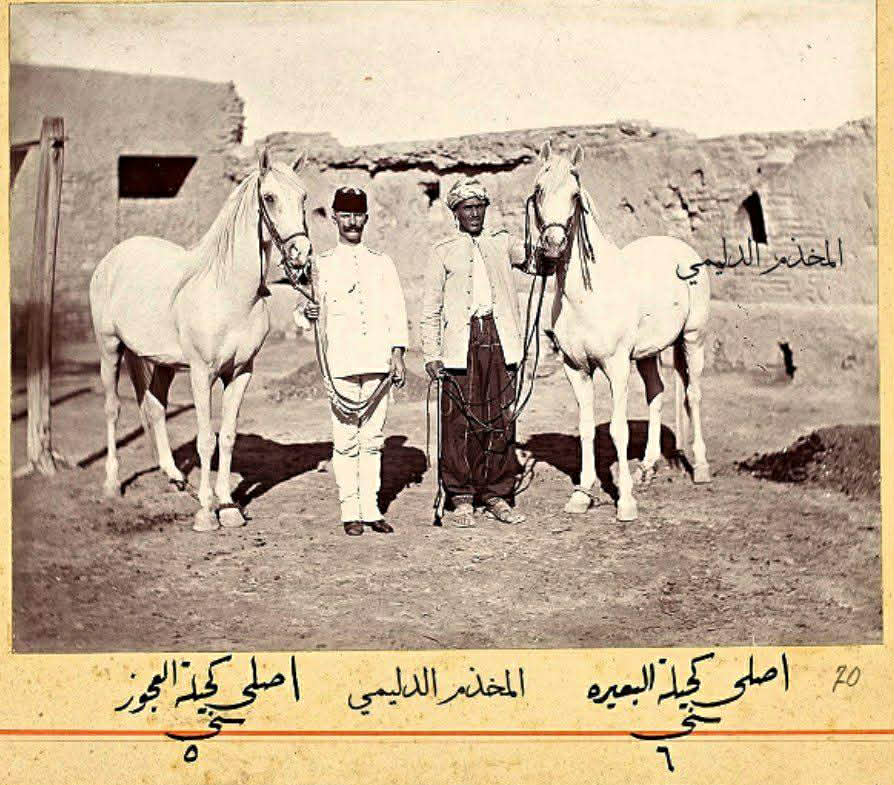
Ahmad Tariq al-Hashimi sent me this old photo, likely taken in Iraq at the beginning of the 20th century. You see an Ottoman official, and the text is in Ottoman Turkish. The mare on the left is Kuhaylat al-Ajuz and the one on the right is a Kuhaylah Bu’ayrah. Both are superb representatives of the breed. They look clean, well noursihed and sport western style bridles. Clearly the horses of a pasha or a high level government official.
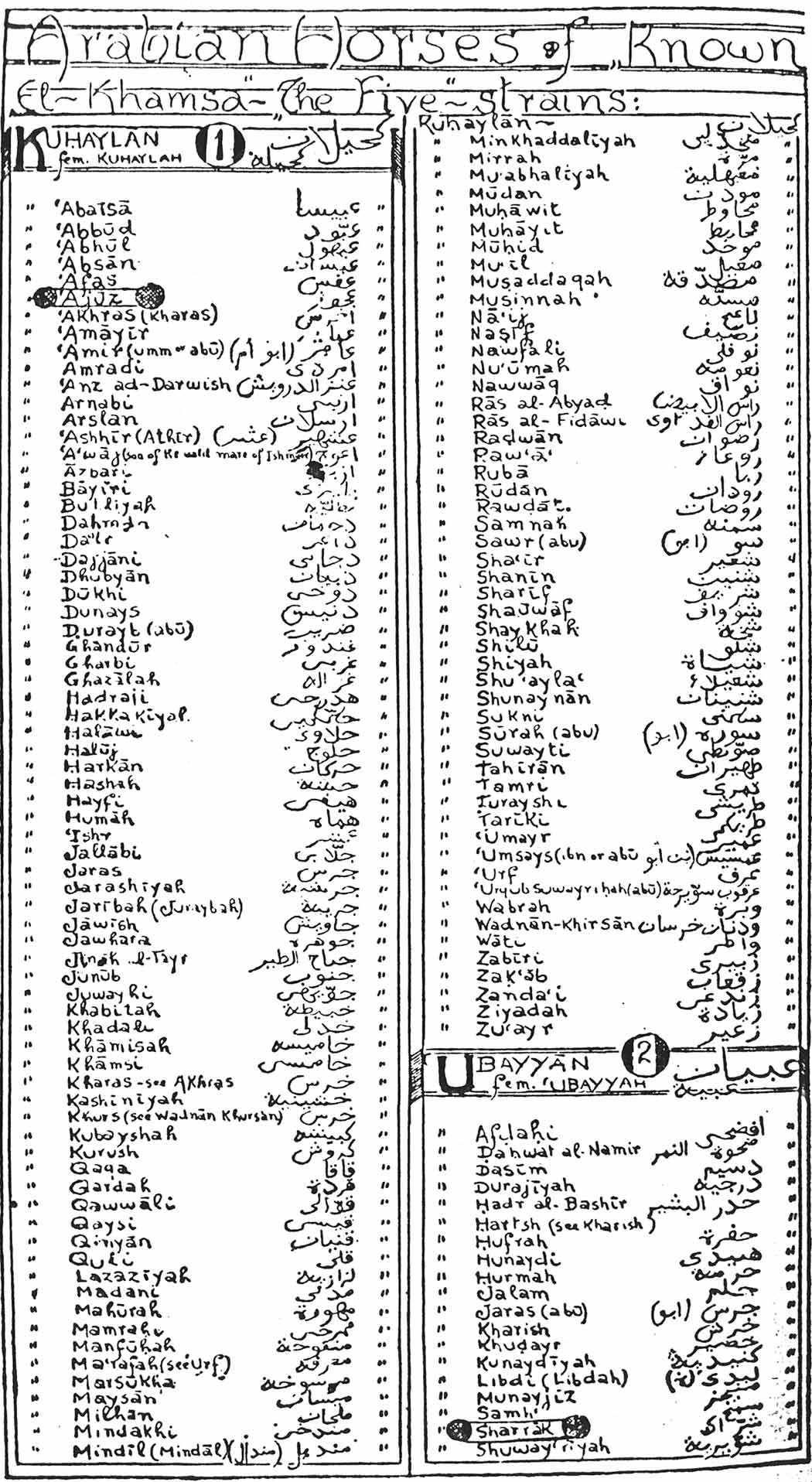
The Bu’ayri (from ba’ir, camel) strain, still exists in Iran today. It is a very rare strain, that appears in several early strain lists, e.g., Raswan’s (below, under “Bayiri”), where it’s the first in the Kuhaylan strains starting with the letter B. It also appears in George Tabet’s 1937 list, as a self-standing strain not to be mated, not under Kuhaylan.
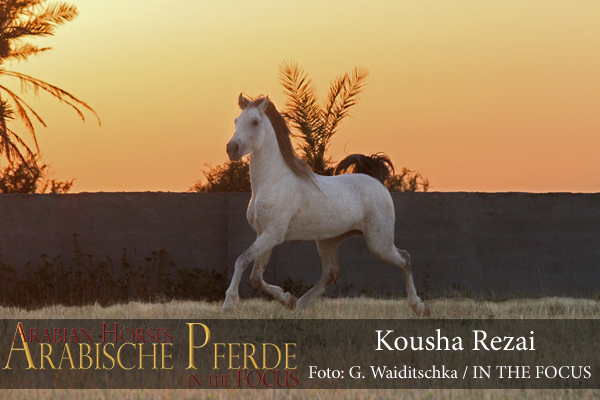
Below, Kousha Rezai, a proud 2009 representative of the Bu’ayri strain. Photo Gudrun Waiditshka.
Oh, a Habib grandson!
The two mares are lovely.
What is the origin of the strain, and why is it named for the camel, do you know?
I don’t know. You might want to look it up in other strain lists. I didn’t find it in Upton
It’s in Tweedie, as Bâ-i-rî; so far, Tweedie is the earliest source I have found to list it, unless it is to be identified as the Buree in Scott Waring, though he says “Anything which inhabits the desert is called Buree”, and mentions there are hawks called Buree as well.
Scott Waning’s “Buree”, actually “barri”, (wahtever leaves in al-barr, the wilderness) which means “wild”
On Bâ-i-rî, Raswan must have gotten it from Tweedie then, they transcribe it the same way. One day, it would be nice to figure out who copied what strain list from whom.
The Blunts list a “K. Báyari” in Vol. 2 of Bedouin Tribes of the Euphrates – the same as the Buayran?
yes, Bu’ayran is the diminutive of Ba’iran, like Duhayman/Dahman, like Shuwayman/Shaman, though Shaman is not a strain.