The stallion Karoun, a Jilfan Jarjari from the strain of the Bani Malek tribe of Khuzestan born ca. 1942, is the main sireline progenitor for Iranian Arabian horses. Genetic Y-DNA studies have found this sire line to fall under the most common Arabian male haplogroup (Ao-aA1a). Below is a table from Kate McLachlan’s recent Khamsat article featuring male progenitors of the Karoun sire line: Ardeshir, Insiatur, Jassem, and the unnamed Wadnan Khursan stallion who may or may not be Karoun’s paternal grandfather.

In turn, he traces back to a Wadnan Khursan stallion from the Hardan tribe. The Encyclopedia Iranica had the following to say on this small tribe:
BANĪ ḤARDĀN, a Shiʿite Arab tribe of Howayza (Ḥawīza) district in Ḵūzestān. Small in number (they were estimated at 2,500 persons early in the century, and at 500 families, i.e., roughly the same number, in the 1930s), their range is comparatively extensive: north of Ahvāz, west of Ahvāz to Howayza, between the Kārūn and the Karḵa rivers, and inland from the left bank of the Āb-e Gargar. Their main centers are Kūt Nahr Hāšem, Dūb-e Ḥardān, and Čārṭāq. Formerly predominantly nomadic (Lorimer, II, p. 120, noted only 100 persons settled), they have progressively sedentarized, cultivating wheat and barley and raising sheep. They are organized into six sections.
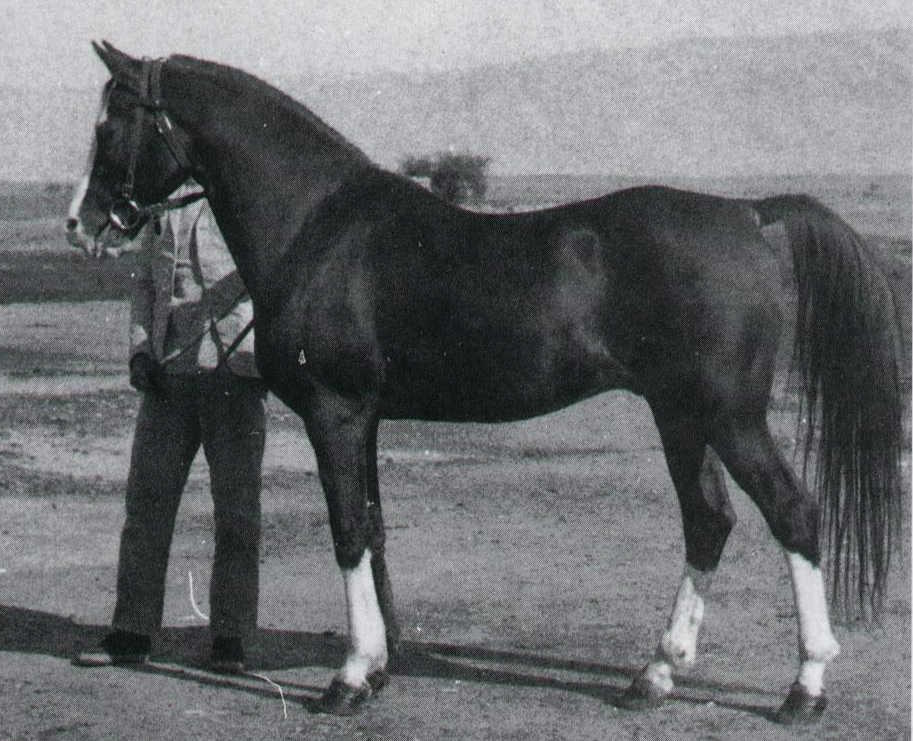
Below, Adjar by Yatim by Karoun, a good representative of this sireline. The photo was taken in Khuzestan by Gustl Eutermoser and pulished by Erika Schiele. It was shared with me by Jens Sannek, who tells me it is in the journal “Arabische Pferde” Quarter III, pages 250 and 251.
Gustl Eutermoser was a rather influencial figure in straight Egyptian horse breeding. To me his most important contribution was Bint Shahbaa, a koheilah krush mare. I like the offspring of her daughter Sohair in France, came close on buying granddaughters of her on 2 occassions. Lots of hidden treasures in France that bred on with EAO stallions and Babson. The offspring of Sohair also occassionally figures in the surviving French asil lines.
There was another daughter Shahd, imported in utero from Egypt, sired by Amlan Eman, that established another damline in both Germany and France. Bint Shahbaa also produced the very influencial Masir (by Mehanna).
Besides that he was one of the leading falconers in Germany and from a family with sawmill operations in Bavaria, there is not much information on the man. He obviously spent quite a bit of time in the Middle-East importing horses from Egypt and Iran.
Hmmm, might have been an interesting figure … WW2 generation German that moved to Austria, spend a lot of time in the ME, moved to Spain. Almost like Skorzeny. His farm lies also more or less half way the German postwar enclaves Atlanterra at the Costa de la Luz and the Barranco Blanco in Malaga, connected through the old smugglers route.
From what I understand he was a professional pilot, and through his association with Prince Muqrin Al Saud (another pilot by training), he imported Saudi mares to Austria that he could not register. I will inquire a bit more.
Meanwhile, my Jasminah was bred to Hayoung yesterday. Hayou is half Iranian and half Egyptian. He is by Hashem (Hamdan II x Bint Shahbaa). I have liked Bint Shahbaa and her son Masir for a long time, after seeing their pictures in Asil Araber volumes. On photo, they are among my favorite historical Egyptian horses in Europe.
So this is why Radovic et al. had a Wadnan Hardan stallion in their sireline data – a Wadnan Khersan of the Banī Hardān. Adjar is a good-looking horse; I particularly like how big his legs appear in this photo.
yes that’s him. Only one Iranian sire line was tested. A potential second one was not tested.
https://www.allbreedpedigree.com/sepid