The black stallion of General Mouzaffer
The photo below comes from the article ‘L’Arabe et l’Anglo-Arabe à l’Exposition hippique universelle’, from Le Sport Universel Illustré, 22 September 1900.
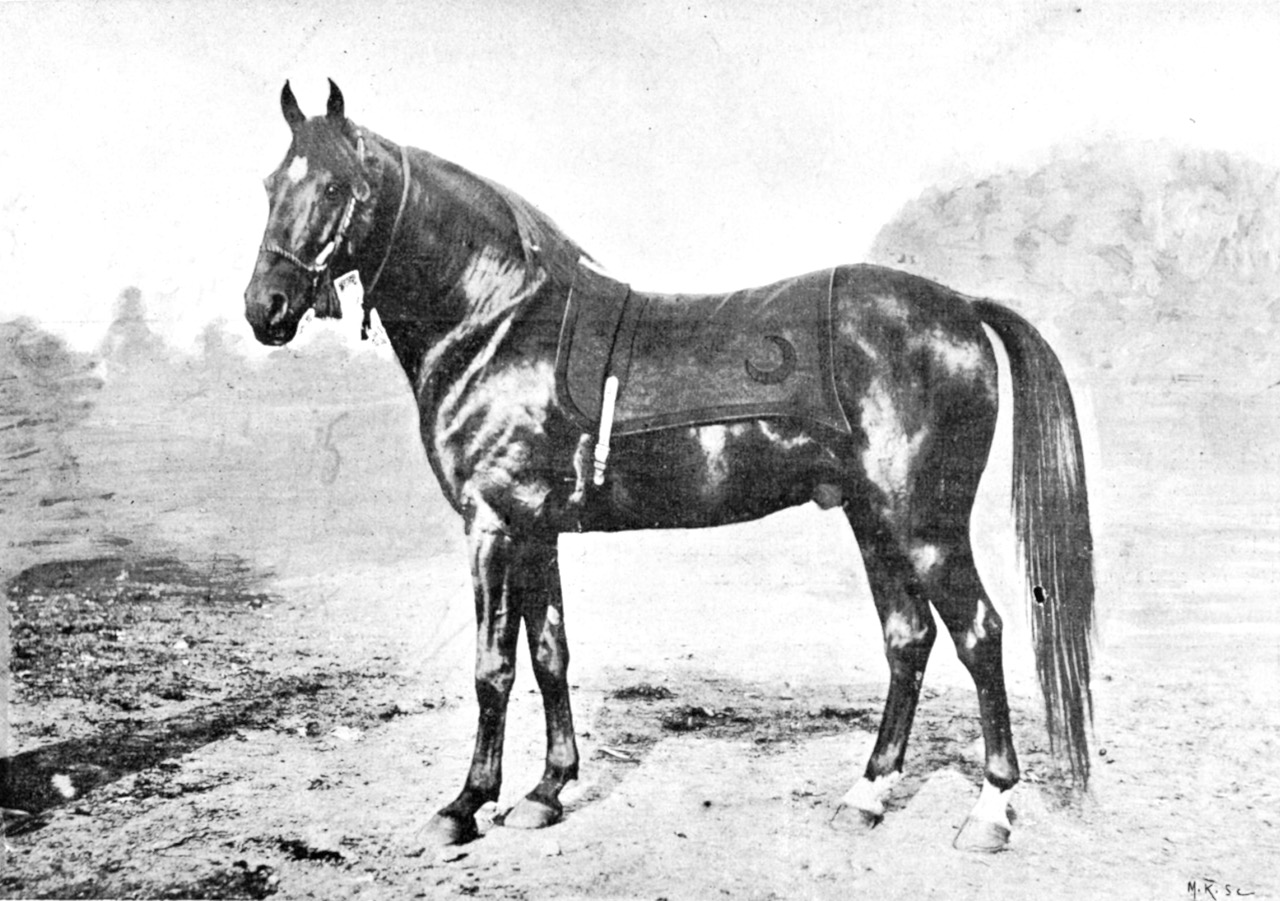
The original caption reads:
DEHMAN-CHUEIMAN
Pur-sang arabe noir, 1 m. 48, né en 1895, dans la tribu Chammar; 1er prix des étalons de pur-sang arabe, appartient au général Mouzaffer
The stallion, bred by the Shammar, was brought from Turkey to Paris for the Exposition Universelle, where he was shown alongside Arabians from France, England, Hungary and Russia, including the three-year-old chetsnut Sinaï (future sire of Djebel), and Mesaoud. I am not certain if Dehman Chueiman is supposed to be the Dahman Shahwan strain, or if the horse’s name is Dahman and his strain Shuwayman. Note that the Pompadour stallion Dahman, foaled in 1900, also came from the Shammar (though he is a Rabdan sired by a Dahman; see Edouard’s post on his hujjah in Mauvy’s Le Cheval Arabe).
The results of the competition are given below (p. 599):
La Hongrie a présenté le plus bel étalon arabe (gris) réunissant la qualité, la noblesse, l’étoffe, la conformation irréprochable: c’est le no 8 du catalogue, nommé O’Bajan-6 (au gouvernement).
La Turquie a cueilli une médaille d’or et 2.000 francs avec Dehman (Chueiman) no 10, à M. Mouzaffer, à Constantinople. Ce étalon de robe noire accuse beaucoup de sang et de trempe, mais sa ligne générale est courte, son dos un peu mou.
Sinaï (n° 7), à M. de Fournas (Carcassonne) est très régulier, de belle robe alezane, de grande ligne; c’est jeune (3 qui un ans) sera remarquable à son complet développement. Il a eu la médaille d’argent et 1.600 francs.
Nedjim, à M. Ali-Mohsin-Pacha, à Alep (Turquie), est très régulier, très bien membré et paraît le cheval utile avec son bon dos, ses jarrets et ses reins. Il a eu une médaille de bronze et 1.400 francs.
Messaoud, à M. Blunt Wilfrid, à Thrée Bridges Sussex (Angleterre), est un beau cheval bâti en père; son dos est la seule chose que sa carrière d’étalon ait déformé.
As a government-owned stallion, O-Bajan 6 was not eligible for prizes. However, he seems to have been preferred to the black stallion, who won first prize, as the writer has only praise for him, while he notes that General Mouzaffer’s stallion has a slightly soft back.
Sinaï took the silver medal, and another Ottoman horse, Nedjim, from Aleppo, the bronze, while Mesaoud placed fourth.
In an article, ‘L’Exposition Hippique Internationale de 1900’, printed in the 15 September edition of Le Sport Universel Illustré, there is another description of the black stallion, as a pretty little energetic horse, who was not, in the opinion of the writer, the best of the Arabians exhibited (p. 580):
Dehman (Chueïman) noir 1m 48 âgé de 5 ans appartenant à la tribu Chammar et considéré par les Orientaux comme étant d’une noblesse relative. C’est un joli petit cheval énergique, plein d’expression, avec de bons tissus, mais un peu court et dont les aplombs laissaient à desirer; il ne nous a pas paru le meilleur des Orientaux exposés.
Wilfrid Blunt writes about the Exposition in his journal (My Diaries: 1888-1900, p. 458):
7th Sept.—To Vincennes with Wagram where we breakfasted, and saw the horses paraded before President Loubet. A Fourth Prize of 1,000 francs has been awarded to us for Mesaoud, and one of 500 francs for Bozra. All the superior prizes, however, have been got hold of by the Sultan, under the name of Muzaffer Pasha, and with the help of his own Inspector of Studs, Fuad Bey, and of one Hector Passega, manager of the Ottoman Horse Show, both of them being judges here, has manipulated the jury and swept the board. There was only one first-class stallion in the Ottoman show, sent from Bagdad, and that has been left out of the prize list. The others are rather ordinary beasts, the First Prize being taken by a small black stallion, whose colour is his chief recommendation. Only one is fit to show at all with ours; however, it does not much matter, as we have had many admirers of a serious kind, and have already sold one mare, Makbula, to Count Strogonoff for 10,000 francs.
He gives his source for Muzaffer Pasha being an alias for the Sultan in his entry for 4 September (p. 457):
Also the Sultan has a number of horses at the show which he has entered in the names of various Turkish Generals, so as to elude the rule making Government studs ineligible for competition. There were some saises looking after them, whom I cross-questioned in Arabic, and they let out to me that all really belonged to the Sultan.
Petite anecdote du déjeuner dominical en parlant de cette photo.
Racontée par Jean-Claude Rajot.
Robert Mauvy avait été emmené par sa tante à l’Exposition Universelle de 1900. Cela représente sa 1ere rencontre avec le cheval arabe oriental. Il avait alors 8 ans.
Son jugement d’enfant l’a porté à préférer l’étalon hongrois O’Bajan. La douceur de cet étalon, son calme, le fait que le grand officier hongrois habillé dans son uniforme d’apparat lui permette de caresser l’étalon, le lui ont fait préférer.
Une fois adulte, il considérait que l’étalon Dehman était bien meilleur, il n’hénissait pas, il rugissait. Et cela effrayait un peu l’enfant de 8 ans qu’était Robert Mauvy à ce moment-là. Et cela justifiait la préférence de l’enfant, remise en question par l’adulte
“Je suis bien certain que quelques années plus tard, j’aurais préféré Shueyman à O’Bajan”
À noter que Robert Mauvy disait que l’étalon noir était un Shueyman Sabbah.
Merci pour l’anecdote! C’est très interessant!
Je suppose que l’étalon a été appelé Dehman parce qu’il était noir, comme les chevaux Kuhaylan Umm Zorayr appelé les Duhm/Dahman pour la couleur de leur robe.