The stud of Sheykh Muhammad B. Salman Aal Khalifah in Bahrain includes representatives of an Arabian horse strain by the name of “Sa’idan”, of which one impressive representative is the stallion pictured below, Saidan Gharib. The photo from the 1998 WAHO Convention in Bahrain.
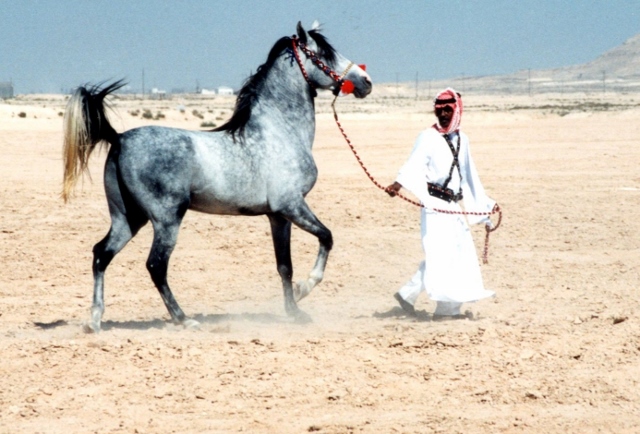
While the strain sounds very similar to the strain of Saadan (as in Saadan Tuqan, the strain of, among others, the mare Francolin imported by the Blunts) they are not the same, and are not written in the same way in Arabic.
It seems that the Bahraini “Saidan” strain gots its name after a Sultan of Oman, Sultan Said bin Sultan. Saidan is reference to Said. Here is a quote from the Bahraini studbook volume 1:
“The Kuheilah Sai’da strain is a family of horse peculiar to Bahrain. The oft told story of how the name came about is still repeated in gatherings when men discuss horses of old and their merits. In the early 19th century the Al-Khalifas had to repel many invaders to ascertain their supremacy in Bahrain. In the year 1816, in one of the attempts to overtake the islands by the forces of the Sultan of Muscat, Said bin Sultan, a big battle was fought on the shores of Bahrain. When the Muscati fleet was sighted approaching on the Eastern coast, horsemen were gathered and positioned awaiting their landing. Although the Muscat forces were greatly superior in numbers and fought fiercely, the shallow water on the shore was to the advantage of the Al-Khalifa horsemen, who were victorious. The remaining of the routed enemy took to their ships and left the shores of Bahrain. When the victorious horsemen returned to their home camp, a Kuheilah mare gave birth to a filly foal. To commemorate the glorious battle and defeat of Said bin Sultan, the filly was named Sa’ida. The Sa’ida at Shaikh Mohammed’s stud are descendants of this mare.”
This events referenced in this account refer to the multiple campaigns that Omani Sultan Said bin Sultan Al Busaidi launched against Bahrain. Four campaigns took place between 1816 and 1828. The one associated with the creation of the Saidan strain is that of 1816. It is mentioned in Sani Ali Bashir’s A Study of Al-Khalifah’s Rule in Bahrain: 1783-1820. Here is the relevant excerpt:
The Su1tan of Masqat was as well contemplating the possibility of embarking on an expedition to capture Bahrain. […] The Sultan of Masqat sailed with his fleet towards Bahrain in 1816. In this expedition the Umanis were given every assistance from the Governor of Fars, in return for a promise of ten thousand Tomans as a tribute to be paid after their conquest of the island. Thus the joint forces under the command of the Sultan of Masqat arrived at the island and were able to land near Muharraq. But the invaders were routed by the forces of the Al-Khalifah and were forced ta abandon their undertaking of capturing Bahrain.
The Umanis lost many men of note in this expedition, especially Hamid the brother of the Sultan.
This is an interesting case of a strain being named after a foe to commemorate a victory over him. It would be nice to know which Kuhaylan line the Saidan strain branched off. Obviously a pre-1815 line.
Hello, I’m wondering if you can help me regarding Arabian horses owners / stables in Bahrain. I am currently doing a photo shoot and would like to hire an Arabian horse.
If you can assist me that would be really well appreciated
I suppose mtDNA may shed some light on the Saidan strain’s original Kuhaylan branch.
Edward Scott Waring, who was in Bengal around this time, knows the “Uby-yu, Soytee, Unezu, Humdanee, Reeshan, Motyran, Diheem, Huzmee, Shumytee Kohilan” as strains from the Najd. He brings up the Buree horses “of Bine Khalid, and those of Quteef, a town on the
main, opposite Bahrein”; unfortunately he doesn’t give their strains.
His contemporary, John MacDonald Kinneir was in Madras; he doesn’t mention Bahrain, rather Bussora, the Montefik and Chob; he also mentions horses from Shustar, Armenia, Koordistan, Bagdad and Damascus. The strains he knows – he doesn’t link them to tribes or regions, so less useful than Waring – are “Kuheilut el ajvez, Showeiman el subah, Uzithin el Khursa, Suglavie ben gedran, Dehma el naamir” for the five, and the rest are “Kuheilu el Samench, ul Muanigieh, Aboyel el nejedis, or Aboyan Kineideish, Aboyan el Shirack, Tereifieh, Mutabuh, Hedeba, Gerade, Zubie, Julfa, Bereisa, Risha, Jouheira, el Naumeh, Curoosh, el Kurry, or el Kerry, Saadeh, Ghureh, Ghuzaleh, Humdanieh, Igithemieh”.
When did Kinneir write this?
Book was published in 1818. Waring 1807.
In one of my previous discussions with an official of Sheikh Mohammed bin Salman Al Khalifa’s farm and stable, I said that I believe that Saeeda is likely to belong to the Dahma lineage, according to my personal analysis of the name, and that her story may be purely fictional (the battle of Sayyid Said bin Sultan, Sultan of Oman, with members of the Al Khalifa army, and that it dates back to 1816). He said to me: And indeed it is. Then I returned to the same man and discussed the matter with him at length. “How did you know that Sa’ida was originally a Dahma?” as I am asked. He replied, “There are two groups or factions within the Al Khalifa family: one group says she is a Dahma, and the other believes she is a Kuhayla, or even a Kuhayla al-Jallabiya.” Then, as soon as one of the modern books on Arabian horses specializing in Bahraini Arabian horses was published…It was certainly transmitted and taken from the oral tradition of the royal family (historical documents held by the ruling family). , they wrote an article about the origin of Sa’ida, commenting that the story of Sa’ida dates back to a local Bahraini battle between cousins of the ruling family (the Al Abdullah faction, which demanded the return of the rule of Sheikh Abdullah bin Ahmed, his sons, and their maternal uncle, Isa bin Tarif, and they nephew, Sheikh Mohammed bin Khalifa). This battle took place in 1846, the year preceding the decisive battle in which Sheikh Isa bin Tarif Al Bin Ali was killed in Qatar (a story mentioned in Abbas Pasha’s manuscript) Which occurred in 1848. This incident is documented, and its details unfolded between the sons of Sheikh Abdullah and their maternal uncle, Isa bin Tarif Al Bin Ali, who were demanding… By restoring the rule of their father and their cousin Sheikh Mohammed bin Khalifa, Sheikh Mohammed bin Khalifa took all of their dahma’at horses that were in the possession of Sheikh Issa bin Tarif Al Bin Ali, and among those horses was the mare of Abdullah bin Naqadan Al Marri, which he took after the killing of Issa bin Tarif Al Bin Ali. It is noted by reading the list of Abbas Pasha’s horses or the list of Abbas Pasha’s horse auction for the year 1860, you will find that there is a dahmeh mare named Saida, owned by Sayyid Said bin Sultan, the Sultan of Oman, which was gifted to Abbas Pasha before that time.
Maybe, but the Saidan don’t look like the Bahraini Dahmans; they look a lot more the Jellabis. The resemblance of the strain name ith the Dahmah mare Saeedah is not enough, in my opinion, to justify a Dahman origin. Mitochondrial DNA anaylsis would help.