Barely Surviving Lines: Courthouse Hamdani Simri line through Safarjal
Don’t ask me how this ancient line made it into the 21st century. It’s a near miracle. Lady Anne Blunt imported the Hamdani Simri mare Sobha (Wazir x Selma) from Egypt in 1891, from a certain Mahmoud Bey who got her dam from the Abbas Pascha collection. Sobha’s line was one of the most represented lines at Crabbet Stud, after Rodania’s and Dajania’s. It produced a stallion at the first generation: Seyal (Mesaoud x Sobha), despite the latter’s grey color (the Blunts were not big on greys). Lady Anne also used Sobha’s other son Antar at her Sheykh Obeyd Stud in Egypt. Seyal’s sire line is still in existence today: Seyal -> Berk -> Ribal -> Ghadaf -> Jadib -> Ibn Gulida -> Omagh -> Dib -> Huntington Doyle, a chestnut 1990 stallion I saw at the Doyle Ranch in Oregon last August. But that’s not what I wanted to talk about here.
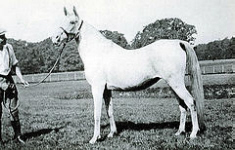
Sobha had a daughter at Crabbet, Siwa (by Ahmar), who had Somra by Daoud, who had Safarjal by Berk. Safarjal was Lady Wentworth’s gift [purchased Thanks for the correction RJ] to Musgrave Clark of the Courthouse stud, which I wrote about in an earlier entry. Clark bred Safarjal to his desert-bred stallion Fedaan, and she produced Somra II. Somra II produced Siwa II by Rheoboam (by Sainfoin who was out of Safarjal x Rangha) hence doubling the Safarjal blood. Siwa II produced Selima by the Saqlawi Bahram (Sainfoin x Betina by Fedaan), for a third cross to Safarjal. Selima produced the two full sisters Sappho (1971) and Sceptre (1977), by Bleinheim, also a Saqlawi, with a fourth cross to Safarjal and a cross to another Courthouse desert-bred stallion, Nimr.
Sceptre, the younger of the two mares, was never replaced in asil breeding as her owners refused to part with her and bred her to non-asil stallions. Somebody (not me) rightly wrote under Sappho’s page on the allbreedpedigree website: “Sappho was one of the last british bred arabians without the blood of polish part bred arabians. all her ancestors trace back to desert bred horses.” I like the straight-forward reference to “part-bred Arabians”, which is what today’s Polish horses really are.

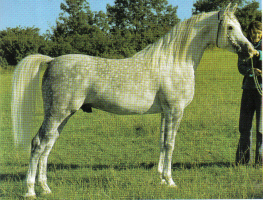
Sappho’s fate was better one. She was bred once to the asil Egyptian stallion Shakhs (Morafic x Shiaa by Alaa El Din), and luckily, she got a daughter to replace her: Selmah, a 1977 grey mare. Selmah seems to have been exported to either Germany or Austria, since she produced a number of asil foals by Egpytian stallions, such as the 1987 mare Sabla, by Jamil (Madkour x Hanan), and the 1989 mare Saree by Jamil’s brother Salaa El Dine (Ansata Halim Shah x Hanan). They must have left some offspring, because such breedings are not coincidental. Both mare are recorded as bred by Mrs. Penelope Pendleton, who is certainly one lucky woman. One needs to get in touch with her to see if she is still breeding, and if possible get one filly from these precious Hamdanis.
I should add two things: first, an acknowledgment of the few preservationnist breeders who tried to obtain either Sappho or Sceptre, and do something worthy with these lines. These include Carol Monkhouse Lee and Tzviah Idan. Second, that another asil line to the Blunt’s Sobha, through *Simawa (Rustem x Sarama), still exists in the USA. More on these better known Sobha descendents another time.