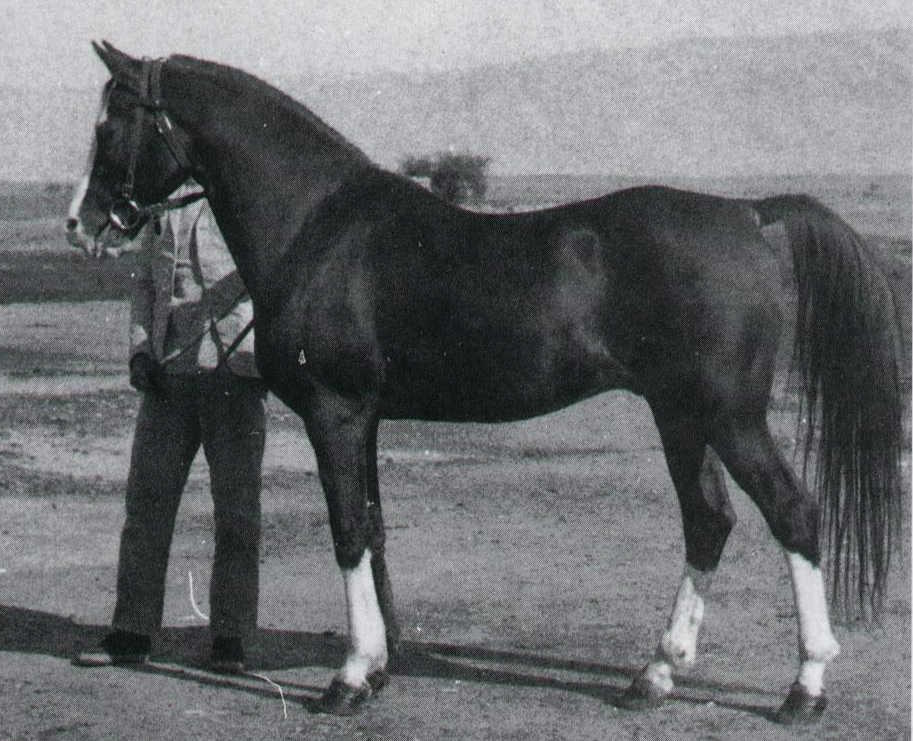
One the main Iranian asil sire line
The stallion Karoun, a Jilfan Jarjari from the strain of the Bani Malek tribe of Khuzestan born ca. 1942, is the main sireline progenitor for Iranian Arabian horses. Genetic Y-DNA studies have found this sire line to fall under the most common Arabian male haplogroup.
In turn, he traces back to a Wadnan Khursan stallion from the Hardan tribe. The Encyclopedia Iranica had the following to say on this small tribe:
BANĪ ḤARDĀN, a Shiʿite Arab tribe of Howayza (Ḥawīza) district in Ḵūzestān. Small in number (they were estimated at 2,500 persons early in the century, and at 500 families, i.e., roughly the same number, in the 1930s), their range is comparatively extensive: north of Ahvāz, west of Ahvāz to Howayza, between the Kārūn and the Karḵa rivers, and inland from the left bank of the Āb-e Gargar. Their main centers are Kūt Nahr Hāšem, Dūb-e Ḥardān, and Čārṭāq. Formerly predominantly nomadic (Lorimer, II, p. 120, noted only 100 persons settled), they have progressively sedentarized, cultivating wheat and barley and raising sheep. They are organized into six sections.
Below, Adjar by Yatim by Karoun, a good representative of this sireline. The photo was taken in Khuzestan by Gustl Eutermoser and pulished by Erika Schiele. It was shared with me by Jens Sannek, who tells me it is in the journal “Arabische Pferde” Quarter III, pages 250 and 251.