The photo below comes from The Rider and Driver of 29 January 1921, and shows a young Jadaan, Jeremah and Beteyen, as well as Hamrah (in the inset oval), and Kokhle (misidentified as her dam Farha).
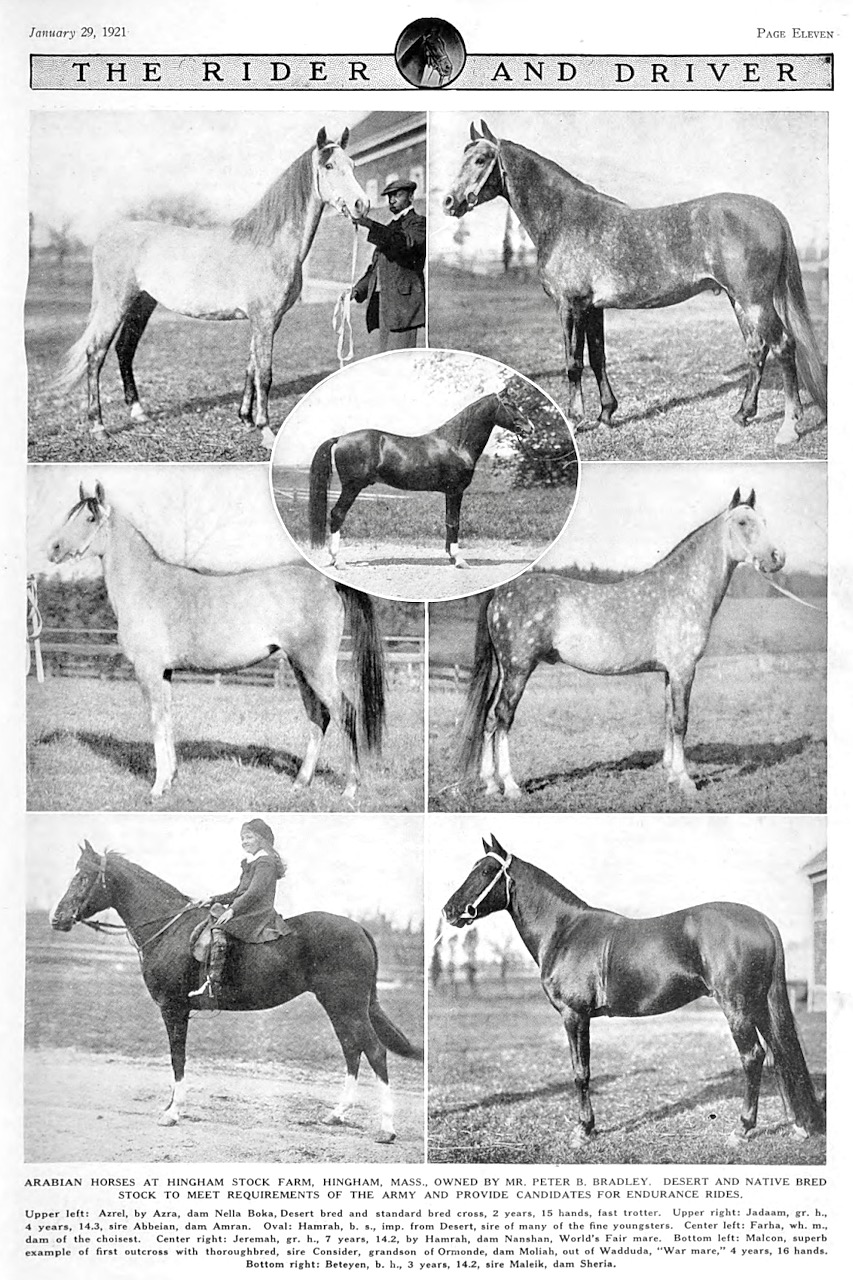
The Rider and Driver also printed two articles on the Hingham horses.
The first, from 10 November 1917, describes several of the stallions at the farm.
Next to come out was the b. s. Hamrah, two white hind feet and one front stocking, that was brought direct from Arabia. The golden sheen on his bay flanks betokened the splendid condition of this handsome son of the Desert. H e has been bred to pure and half bred Arab mares, also thoroughbred mares. This horse comes of the Seglawi Jedran family which is said to be the most popular of all the families of the Arab horse and considered by many Bedouin tribes better than any of the other desert blood. Only a few are left among the Anezeh tribes, the late Abbas Pasha having bought nearly all of the Jeglawi [sic] Jedran, paying such fabulous prices as $15,000 for a single mare. Hamrah was bred in 1904, has immense power and the finest possible action under the saddle in the gallop.
After Hamrah came Letan, who gave the writer an opportunity to wax lyrical on Muson:
In artistic contrast to the golden bay of Hamrah, the […] groom, either intentionally or otherwise, next led out Letan, a gr. s. with steel colored mane and tail and mottles of deeper shades over his sleek body. This horse by Muson, a picture horse of great substance and an animal of marvelous endurance, was proven by the fact that in shipping from Arabia he stood on the forward deck of the vessel without lying down for nineteen days.
Muson, the sire, comes of the Keheilan family … Muson was himself a white stallion, bred in 1889 and of spectacular beauty. He descends from the historic mare that “stood listening” in ancient times and is supposed to have heard approaching danger. Muson created a sensation in Madison Square Garden in 1907 while ridden by Col. Cody, (Buffalo Bill) in his Wild West Show. A number of his colts born in America are most highly prized by their owners and reflect his wonderful individuality.
The Nanshan son Jeremah followed:
Jeramah [sic], another gray with white dapples, had the misfortune to lose his dam when only two weeks old and had to be brought up on cow’s milk. He is a beautiful three-year-old stallion by Hamrah and promises to equal his sire in speed, gameness and saddle horse qualities.
Whatever his qualities, Jeremah seems to have sired only one registered foal, the mare Zoba, out of his half-sister Hasiker. Zoba’s daughter Daud left foals sired by the Czubuthan son Pelkinie; her second daughter Feisal produced foals by Pelkinie, Lotnik and the Skowronek grandson Jarid, as well as a filly Reshan Azab, by Janeo (King John x Babe Azab), who has two generations of descent in the Al Khamsa Roster. This was the only Al Khamsa line tracing to King John. Feisal also had a daughter Bahdrina, by Bahrdin, a stallion of entirely Blunt Crabbet blood.
Deyr’s son Harara came in for praise as a desirable cavalry type:
All the armies of the world are now looking for short-legged horses, not too tall, and one of those that appealed to us was Harara, a ch. stallion five years old, by Deyr. This horse was imported from the Desert and stands scant 15 hands.
Deyr is a golden ch. s., 14 years old, with white blaze and left hind sock. He came direct to America from the Desert and is leaving his impress on the horses in his new found home.
Next was the young Wadduda son Yemen, called Lenan by the magazine; the writer preferred to dwell on the exploits of his dam, however. He was followed by a chestnut whom I believe is Moharra, the son of Abeyah:
Monara [sic], a beautiful liver colored ch. s. next made his appearance and gave us a thrill of the oriental atmosphere he carried. He is eleven years old and came to America in utero, now standing 14.1 and being a rare type to get polo and army mounts.
Another Abeyah son, Maleik, followed; apparently the editor of The Rider and Driver was one of the judges who chose his sire Haleb as “the most typical horse for Morgan breeders at the Rutland Fair Horse Show”. Maleik was not himself described, but Haleb was praised as being “a beautiful animal, compactly built, beautifully fronted, and docile as a child.”
Also seen was the three-year-old Fartak, son of El Bulad and Farha, who “seemed more like a thoroughbred than an Arab, standing 15.1 and being a superb specimen of the breed”.
In February 1921, a follow-up article to the photos printed in the previous issue of The Rider and Driver, wrote briefly about the Hingham Stock Farm and its horses.
Hamrah came in for more praise, as the senior stallion at stud:
Hamrah, the premier sire, is Desert bred with a golden sheen and white star and not a blemish on his fluted legs or burnished body. He has proven to be one of the surest of foal getters. A lot of young colts reflect him credit, such as the beautiful gray Jeriemah [sic], dam Nanshan (the World’s Fair mare), standing 14.2, with superb bone and the usual width between the eyes denoting proverbial Arabian intelligence.
Also singled out were Jadaan and a son of Maleik:
There are other good-looking ones by other sires such as Jaddaan [sic], by Abbeian, 14.3, a four-year-old that will grow to 15 hands, a stout made one, and Nissaab, a beautiful bay with black points and star, by Maleik, a three-year-old, standing 14.2, a grandson of Haleb.
The filly Paulan (Fartak x Meleky) “is of the polo type, and was sold to the Japanese Government”, while the yearling Mershid is described as “a beauty that lit up the place … a gray with a strawberry belt”.
This is great to have, and nice work, Kate.
Nissaab however was a chestnut son of *Muson and *Urfah, not Maleik. The only bay three-year-old colt by Maleik would have been Beteyen, pictured above.
If Paulan was indeed sold to the government of Japan, no transfer of ownership was recorded with the Arabian Horse Club. The 1927 stud book shows her still in Hingham Stock Farm ownership and deceased.
Monarra has to be *Moharra. He remained in Hingham ownership all his life but never sired a registered purebred foal. There is a note in his Arabian Horse Club records that he was loaned to Robert Tait of Lynchburg, Virginia, but no mention of when this was or for how long.
As for *Abbeian, I wish these authors would do more than just mention his name. A few words about his age and desert origin, the same as elaborated for *Wadduda and other parents of horses seen and described, would be very helpful.
Did they breed many outcrosses at Hingham? I note the top left cross with a Standardbred and presumably the bottom left photo of Malcon shows he was an Anglo-Arab out of the Wadduda daughter Moliah? Very interesting to see.
Yes, only about half the horses in 1910 where Arabian, RJ tells us.