On the various strains of Iranian Arabians, by Mary Gharagozlou
Quoting from her article on the Asil Horse of Khuzestan (full article here on the WAHO website), a good starting point for information on this topic:
Of the tribes mentioned by Layard in the first quotation, branches of the Al Khamees, Al Kathir and the Bani Lam are existent today in Khuzestan.
The Bani Lam and the Al Kathir are known for the foundation of certain strains, the former for the Saglawi Djadrani, and Nesman (branch of the Koheilan), the latter for the Hamdani Semri, Saglawi Djadran, Wadne and a Wadne branch known as the Zaghieh.
The Kaab, under whose name General Tweedie recognizes the Arab of Iran, are a large tribe divided into sub-tribes. Those best known for certain strains are the Jassemi for the Hetli (a Koheilan derivative) and the Sofferieh (a Saglawi sub-strain); the Mojadami known for a branch of the Hamdani, the Sobeili and Beaiyreh (Wadne Koheili).
There are the Bani Khalid famous for Soffeirieh and Djelfe (Julfa to Layard); the Seyyids of Hosseini with the Maanghieh (Maneghi); the Seyyids of Tefagh with the Koheilan Adjuz, the Nesman and the Djelfe; and the Ziareh are best known for their Saglawis.
However, the strain whose stallion is accepted by everybody as faal (worthy for breeding ) is the Wadnan Khersan of the Mir tribe, who also own the best considered Obayan Sharak.
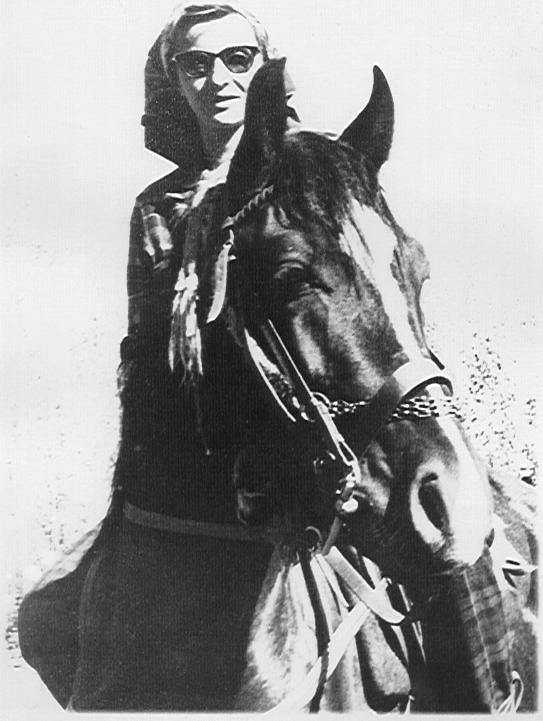
Mary Gharagozlou riding her black Ubayyan Sharrak stallion Arras, from her obituary on the WAHO website. Her obituary in the Guardian reads like a script for the best movie Hollywood never made.
Another relevant quote: “The strains inherited by Majid [Bakhtiar, her husband] were the Wadnan Khersan, Obayan Sharak and Hamdani. He himself obtained a Nesmani mare from a cousin, and put an Obaye mare in partnership with a Djelfe mare with Seyyid Askari, who had obtained them from owners famous for them, the Seyyids of Tefagh.”
For those interested and who have not seen this old film, featuring Mary Gharagozlou, I am copying this from the WAHO website:
WAHO is pleased to offer you the chance to watch this fascinating historical documentary film made in Iran in 1978 by Gerald Weinbren, featuring the late Mary Gharagozlou. It is called Migrate to Survive and tells the story of the annual migration of the Arabian horses to better pastures. It shows a wonderful slice of history and a vanishing way of life from 45 years ago. It is about half an hour long, and is now freely available to view on Youtube at this link:
https://www.youtube.com/watch?v=hsRGa0q6n5w
Hi Kina, thank you for posting the link. I had been looking for it. Wonderful movie. Is that the late Dr. Gazder standing next to Mary in the opening minutes of the movie?
Yes Edouard, that is Pesi – it must have been during the first WAHO inspection visit in 1974, or possibly the 2nd in 1977. I can check who the other members of the WAHO team were – I am fairly sure it was Don Ford and Claes Lewenhaupt.
The movie was produced in 1978, so the second visit is more likely.
I have several favourite parts of that article of Mary’s, one of them is the visit to Sheikh Hajat with some friends she had met through WAHO, It’s important to note that Gustl Eutermoser and Ulrika Marcik were later to bring several horses of Mary’s breeding to Europe, in interesting circumstances due to regime change and the danger to the Royal Stud’s horses, Here’s some of it:
“It was during this period that I found friends among Arab horse breeders elsewhere in the world, among them Gustl Eutermoser and Ulrika Marcik who I met in Sweden. They asked if they could come to visit me. I explained that I lived in an isolated area, the road somewhat undefined and my home hard to find. However, I gave them a primitive map and thought little more about it.
Quite late one rainy night sometime in the early spring of Khuzestan, the rainiest season of all, I heard the horn of a car at the gate. A Range Rover entered the courtyard. I was surprised, for the only person I knew with such a car would not have chosen such a wet night. Not only was the road bad, but there was a river to cross which, though not wide, could have dangerous flash floods. My surprise was all the greater when out of the car descended Gustl and Ulrika, together with a lady from Australia and a man from Germany. For two days we had hurried, dripping visits to the stables, not very pleasant in the incessant rain. Bored, they asked me if there was a sheikh we could visit, who was reputed for his traditional knowledge of the Asil? Sheikh Hajat of the Al Kathir, said to be one of the most authoritative men on the dispersal and fame of the strains of Khuzestan, lived not more than forty kilometers away. It was at the risk of becoming stuck in the mud that we decided to attempt to go to him. We had a fantastic drive which was more like sailing on a sea of mud than driving, but we eventually got there, cold and very wet.
Sheikh Hajat, whom I knew well, was very glad to see us. He had been a good friend of Majid’s and was one of my instructors in the field of the Asil of Khuzestan. He had an enormous brazier of red-hot charcoal set before us, and once we were warmed by tea and coffee, the conversation turned to my guests and the reason for their presence. They wanted his opinion as to the qualifications of a good Asil horse. He said: “First ask them which horse they are talking about. The horse of the “khiaban” (avenue, meaning a horse for showing off, festivities etc.) or a horse of the “biaban”? (the desert or the wilderness, meaning a horse for fighting, long distances, speed for hunting etc.) The reply was “the horse of the biaban”.
He then replied: “First, before looking at the horse’s body, you must ensure that it has the five specifications of character: Courage. Intelligence. Stamina. Spirit. Above all “Nejabat” (a difficult word to translate, a mixture of nobleness, gentleness and the ethics of an aristocrat). If it lacks these virtues, no matter how pleasing he is to the eye, he is a worthless horse, so do not waste your time.”
Indeed, this section reads like the best of Lady Anne’s or Doughty’s travel narratives.
Dear Edouard, I hope you do not mind me adding a little more to this topic. Mary was one of my all time heroes and those of us privileged to know her will never forget her, so remembering her in this way is important. The article on the WAHO website is a shortened version of it as published elsewhere – here is the original introduction. Mary was indomitable, even as a 10-year old child.
“Apparently, the first thing I must do is introduce myself. This I shall do in as far as it concerns my contact and involvement with the Asil (for the west ‘Arab’) horse. My name is Mary Gharagozlou. Speaking horsewise, by blood, I could be classified as an Anglo-Mongol, my mother being an American of Anglo-Saxon origin, and my father of Mongolian stock. By nationality I am an Iranian, and I would like to add, I love my country and would not wish to live elsewhere, though I have visited many others. My father was a doctor who commenced his studies in France and Switzerland, finishing them in the States. At that time his father represented Persia as Minister to Washington. To the best of my knowledge, my father, once he had his degree, had acquired a permit to practice in the States and intended to remain. However, he met my mother. When they decided to marry, much against the desire of her parents and his father, it was she that wanted them to come to Iran, in her opinion a romantic country of nightingales and roses, so they did.
Instead of setting up medical practice in Teheran, the capital, which would have been the normal thing to do, he removed himself to the provincial town of Hamadan. Once known as Ekbatan, it had been the summer capital of the Achaemenian Empire two thousand years previously. In the province of Hamadan, my father’s family, previously a tribe, owned many villages. My father took on the responsibility of managing his own and those of his father, setting up his home in a cool, roadless, mountain village. My parents built themselves a house and an ideal style of life. He set up clinics for the inhabitants of the villages. He was content, and everybody was happy. All this was cut short by his death at age thirty seven for him, six for me and three and a half for my sister.
At the early age of three, my father, an ardent horseman, would take me in front of him in the saddle. During the second summer of this activity I had my first, and oddly enough, worst accident that was ever to befall me on a horse. Suddenly, coming upon a low branch that crossed our path, my father was obliged to bend down. The saddle we were on was one that had been bought specially for my mother, who was altogether terrified of horses. This saddle had a high, studded pommel. The result was that my nose cracked into the pommel and broke. To this day it has remained crooked.
After my father’s death we children always had horses which were kept up in the mountain village, by name Varkaneh. However, these horses were of no particular breed. I met my first Arab when I was ten. He was a chestnut stallion called Ilderim, originally a gift from Saudi Arabia to our king. He had then been lamed in racing and been given to a Colonel of the cavalry. Some past bad experience had taught him to dislike men, as happens sometimes, and he was considered a dangerous animal. However, during the start of a paper chase and not liking the horse I had (being the youngest rider by far and very determined to win) I went back and due to negligence on the part of some soldiers, undid the horse I liked, which was Ilderim, and rode off. He behaved like a lamb. After that I was allowed to have him in later paper-chases, however no one explained to me that he had a bad tendon and I must be careful with him. Galloping down a sandy river-bed, he suddenly slowed down, took several three-legged bounds and stopped. Not to go into too much detail, I carried on and made such a fuss, that my uncle, who was at that time our guardian, agreed to buy him for me. A Turkoman sergeant volunteered to try to cure him. He took the horse away and four months later came cantering up our street with the horse no longer lame. Ilderim was already over seventeen, and a few years later, due to expenses we could not manage, was put down. For several years afterwards my equestrian activities were restricted to the Turkoman horse, at that time used for racing and jumping. I took part in both, in racing only in training, and in jumping only practicing, for there were only competitions for the military.
This was my state of affairs until I met Majid Bakhtiar and we decided to get married. He was a member of the chiefs of the Bakhtiari, a tribe inhabiting the region west and south-west of the province of Isfahan. Their winter quarters were in the northern boundaries of Khuzestan, the oil and Asil producing province of Iran. He owned properties in this province, also a stable of pure-bred Asil horses, both inherited from his father. The horses that had been obtained by his family, who were at one time powerful, were mostly as presents from sheikhs with whom they had alliances. Others were taken in battle, such as two Wadne Khersani mares from the Mir tribe. Gradually, I learnt the rules and regulations that were considered necessary for the breeding of Asils, taught by him and by those with knowledge of the old traditions.”
Hi Kina,
Thanks again for sharing that excerpt of the larger article. If you don’t mind, I am going to “promote” your comment to a full post. Would you have the link to the larger piece?
Hi Edouard – feel free to do as you wish. I don’t have a link to the whole piece – which I think is from the July 2000 issue of Arabian Horse World – but it was almost identical to the article you have already linked to on the WAHO website, just without that particular introduction which I put here mainly for the lovely story of Mary aged 10 and her first contact with an Arab stallion, who was clearly not regarded as an ideal ride for a child 🙂
I met Mary at a WAHO meeting in London and arranged to send her medicine (I am a veterinarian)for some of the Arabian horses that she kept safe in the Mountains. After a couple years I could not longer reach her and the intermediaries that we used disavowed any knowledge of her. I never understood what happened to Mary and to the horses. I would live to read any articles she wrote.
Thank you