Five years after Bogdan Zientarski and Carl Raswan’s 1931 horse-buying trip to Arabia including Bahrain, it was the turn of Dr. Ahmed Mabrouk to make a similar trip for the Royal Agriculture Society (RAS) of Egypt. In 1936, he visited the stud of the ruler of Bahrain, Shaykh Hamad Aal Khalifah, and had the following to say about it:
I was introduced to the Amir, brother of the ruler of El Bahrein, who allowed me to see his horses and those of his brother. All the pedigreed Arab horses are in the possession of the Hamad family. Photographs and descriptions of some of these horses are published in the following pages. I regret to say that these horses, like those of Amir Galawi [Edouard’s note: Amir Saud Ibn Jiluwi in al-Ahsaa in the neighboring Kingdom of Saudi Arabia] are not desert bred, but confined in two stables, one situated near the ruler’s palace and the other at a distance of 60 kilometers from El Manama, the capital of El Bahrein, where the winter palace of the Amir is situated.
Dr. Mabrouk left us photos and brief descriptions of seven mares, two stallions and one colt that caught his eye. He must have seen more horses that he did not mention in his book. The seven mares are from the Jazian, ‘Ubayyan, and Jallabi strains. The one stallions is identified as:
8. El-Gallabi El-Asfar, Flea-bitten, by El-Chawaf (no age, height or further description given)
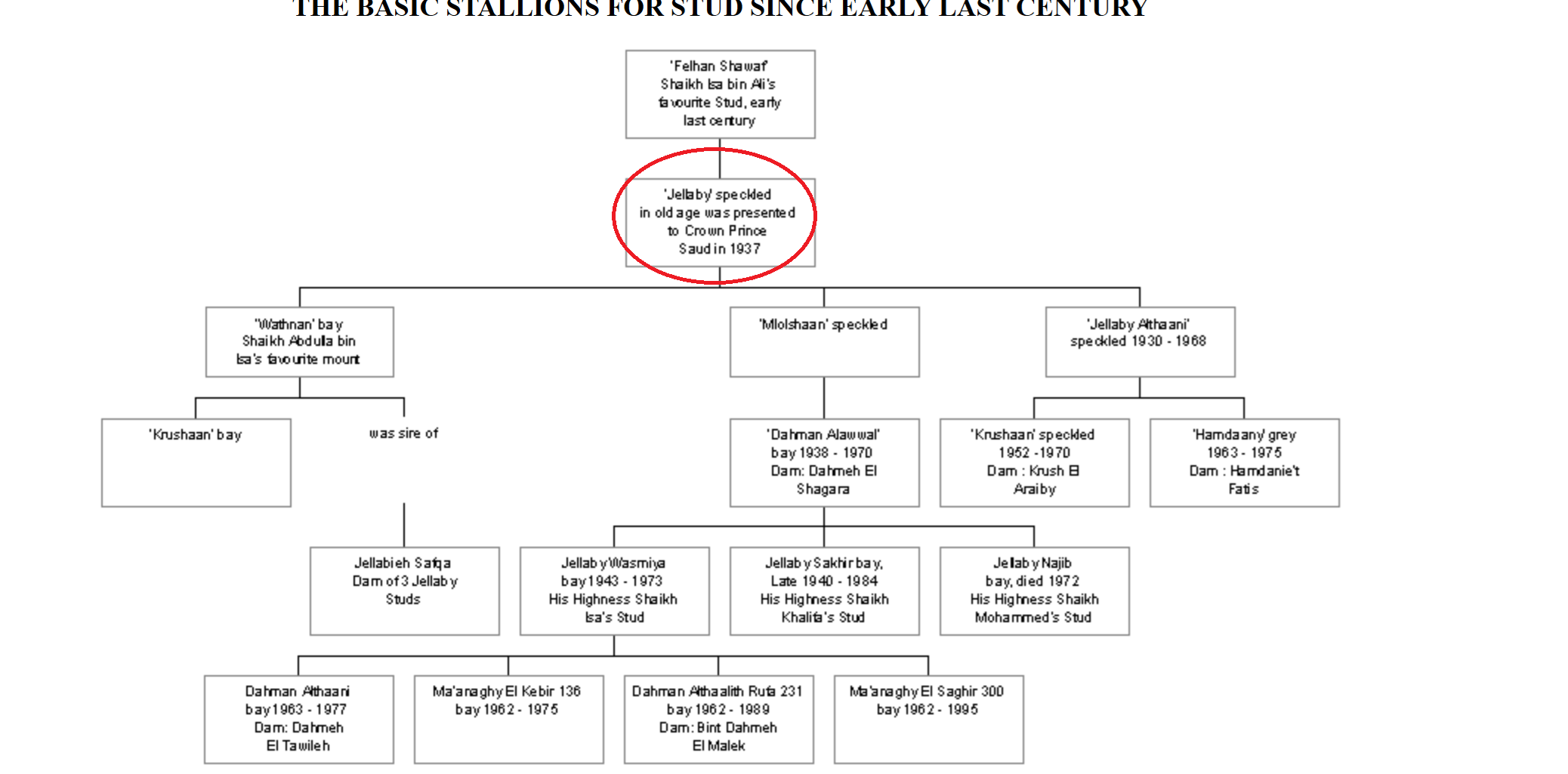
This looks to me like an exact description of the First Old Speckled Jellabi (Jellabi al-Marshoosh al-Awwal). Everything matches: the strain (Jellabi), the color (flea-bitten, in Arabic marshoosh), the sire (a Shawaf or El-Chawaf, as French-influenced writers like Mabrouk to spell the strain), and the date of the visit (pre-1937, so one year before when the table below says that this stallion was presented to the Crown Prince of Saudi Arabia). This First Old Speckled Jellabi is the sire line ancestor of all Bahraini modern horses.
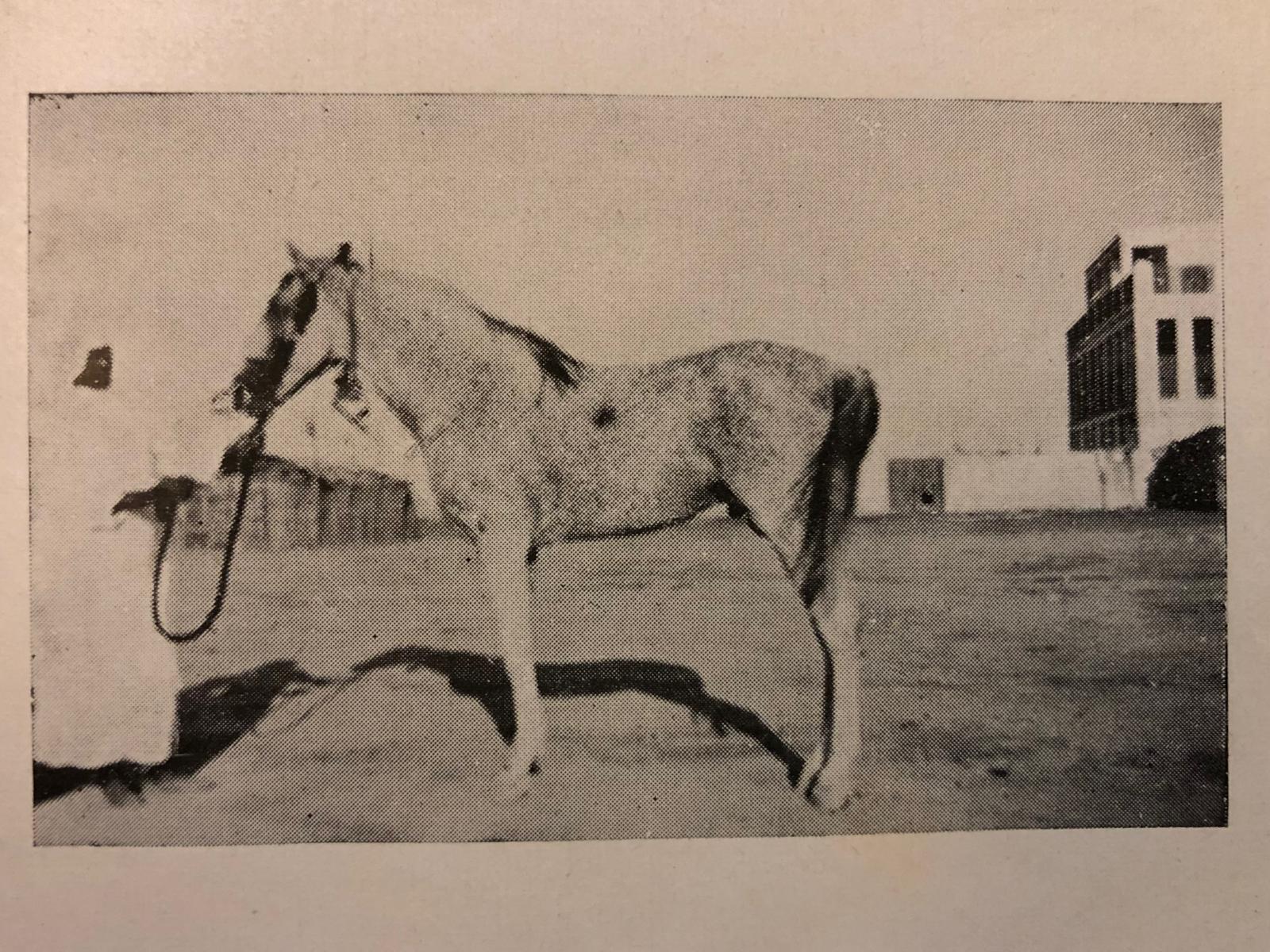
Even more, it may well be that Mabrouk left us a photo of that stallion. His photo below is captioned: “Stallions of El Bahrein” and shows an older flea-bitten stallion representative of the “Bahraini male type”: high off the ground, short back, small round croup, thicker neck, and good bone.
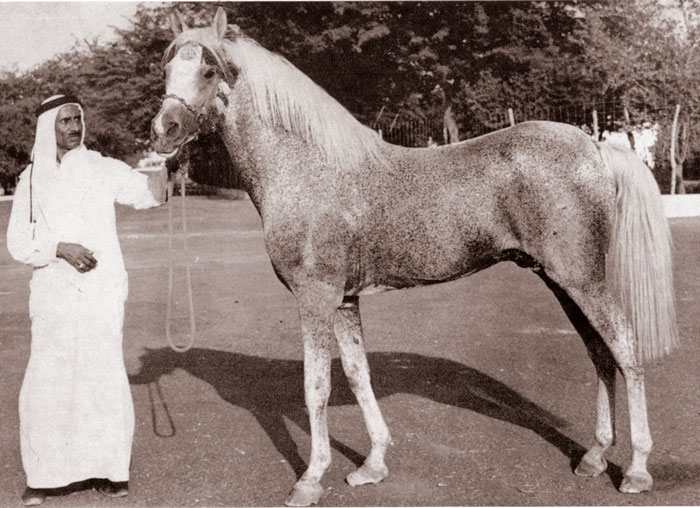
Below, his more famous son in extreme old age, the Second Old Speckled Jellabi (Jellabi al-Marshoosh al-Thani), born in 1930 with Hasan bint Salih al-Ruway’i. He must have been six years old at the time of Mabrouk’s visit. Notice the similarity between the son (below) and probable father (above).
Oh, an intriguing possibility! The horse in the photo has an extremely short back, even accounting for the length of his legs making it seem shorter. Not much room for a saddle! The shadow makes me wonder if there’s any foreshortening adding to the effect. Very good substance in the legs, though, especially given how long his cannons are.
So if Mabrouk thought that the flea bitten greys’ ,’ small round croup,’ was somehow detrimental he proved he was ignorant of good functional athletic conformation. A rounded croup enables a horse to get under neath his body mass with his hind legs and lift his back into an arch called bascule. Bascule is how horses move. A flat, stupid, upside down back and inverted neck is how cows move. Cows are not horses. Cows are not ridden. Horses are ridden. Horses like todays halter horses- both arabian and quarter horses for example will simply not stay stay sound when asked to carry a rider for extended periods of time. Inverted horses are prone to kissing spines.
And anyway a horses length of hip is what determines how much power their hindquarters have. Not the croup. A rounded croup will more easily enable the horses sacrum to ,’ hinge,’ downward allowing bascule . See above.
Mabrouk was a fool for not follwing Zeintarsky, and Raswans footsteps in not moving heaven and earth if necessary and getting Bahrainy horses for the EAo- doing so would have further enfused athletic conformation into Egyptian horses. Something todays Egyptians desperately need.
best