The photo below was the cover image of Sports of the Times, Vol. 13 No. 13, 27 March 1909, showing a grey stallion belonging to Homer Davenport, ridden by Said Abdullah.
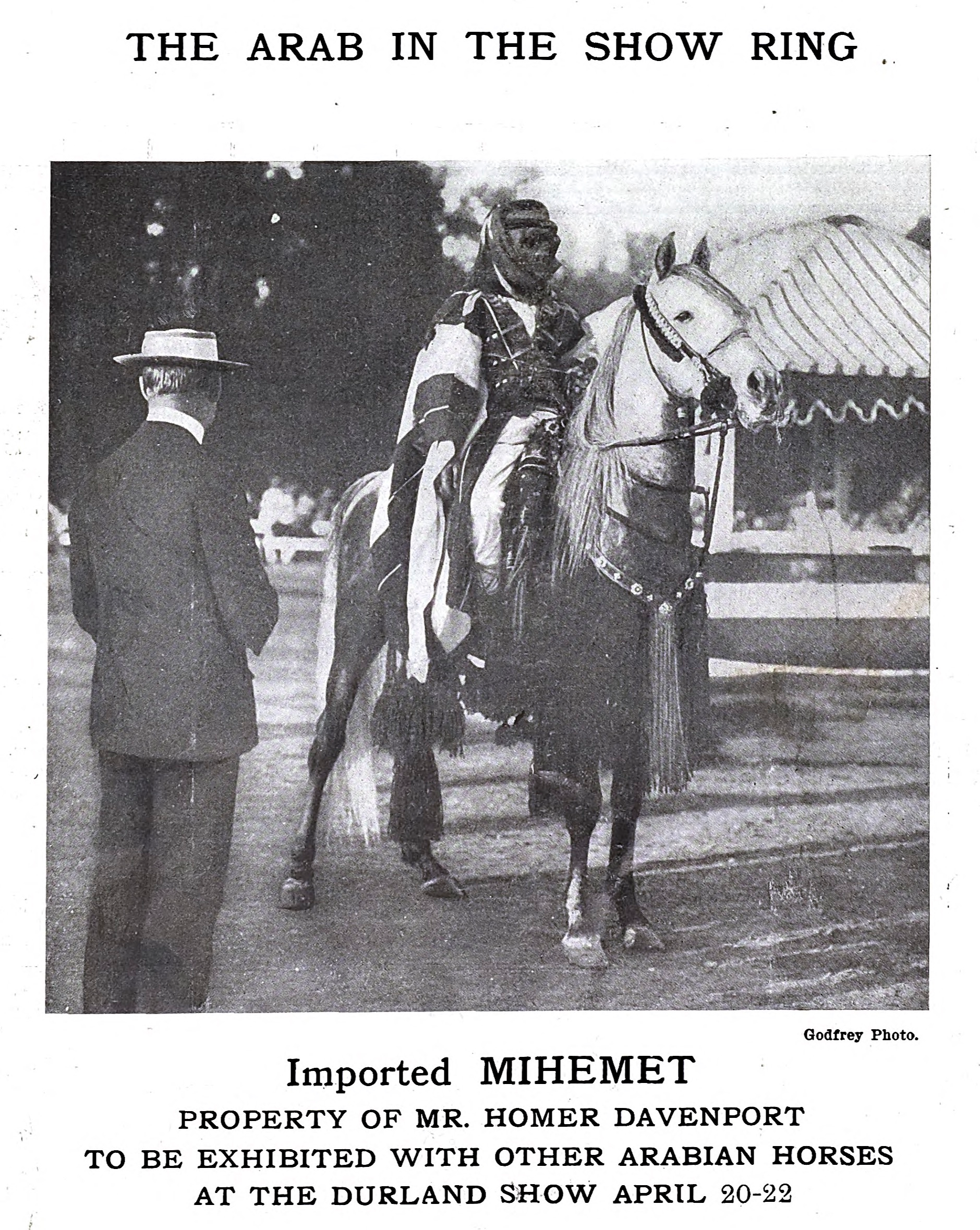
There is no other record of a Mihemet owned by Davenport. The article accompanying the image does not shed any further light as to who Mihemet might be, beyond saying that he was purchased from the “chief of the Anezah tribe” (p. 261).
In an email discussion of this photo and the identity of the horse, options mooted were Thompson’s Grey, Moore’s Grey, El Bulad and Masoud. Moira Walker ruled out Thompson’s Grey, who had “pretty spectacular white stockings”, notably missing from this horse. Michael Bowling noted that El Bulad also had white on his front legs, again unlike this horse, and suggested that Mihemet was Masoud, a 1903 grey stallion imported by Homer Davenport.
Incidentally, the discussion also led to Moira, Michael and me independently locating a name for Thompson’s Grey, Ali Bey, in three separate sources; by way of further interesting facts, he was apparently only 13.1 hh, and described by the Sport of the Times, 2 May 1908, as “remarkably well put together” and “a very attractive little horse”.
The Breeder’s Gazette, 28 April 1909, p.1014, gave a précis of the results of the Durland show at which Mihemet was to be exhibited, but again, does not help identify the horse.
“The sensational feature of this show, at least to a large part of the spectators, was the exhibition of 14 Arabian horses under saddle. This is the first time in many years that a class for Arabian saddle horses has been made at any show in this city, and why it was made in this instance was not understood by most of the devotees of horseback riding. It is claimed by the admirers of this breed of horse that in many respects he is the superior of the American-bred saddle horse, and considered from an educational standpoint it would have been more satisfactory had these horses been shown in the general saddle horse classes, where they would have had to compete with the American horse, so that breeders and others interested in the saddle horse might have the opportunity of determining the merits of the respective breeds as developed by competition. Among those shown were five stallions imported by Homer Davenport, Spencer Borden exhibited two stallions and two mares, Max A. Mosle entered two stallions, Lieutenant Frank B. Barrett of the First Battery Field Artillery exhibited a chestnut gelding, Edward L. Tinker exhibited a chestnut stallion and N. J. Hess the well-known bay gelding Abdallah. Nearly all of the entries were but little over 14 hands high and were probably as good if not the best specimens of this breed now owned in this country. Like all other Arabian horses their muscular development was exceedingly deficient; their bones were light, their conformation smooth, and many of them showed a breedy appearance. But when it came to saddle gaits they were clearly outclassed by many of the novices known as the Kentucky type of saddle horse. It is not probable if they had been shown against the better class of American horses that either one of them would have won a blue ribbon. One of those exhibited by Mr. Davenport was the white stallion Muson that has been shown at several local shows since his importation some three years ago. He was not considered by the judge as being entitled to a ribbon of any kind. The one that Mr. Ramsdell liked best was the bay stallion Hamrah, owned by Mr. Davenport, while most of the spectators preferred the chestnut stallion Euphrates, also owned by Mr. Davenport, and placed second. The brown stallion Haleb, that Mr. Davenport claims was the best specimen found on the Arabian Desert, was not considered to be the equal of the others, and it may be fairly said that his gaits were not as satisfactory as those to which the blue and red ribbons were awarded. The only ribbon-winner exhibited by Mr. Borden was the chestnut stallion Segario that was placed fourth.
“These horses left the impression that they were better suited for pets for women and children than for general purpose saddle horses and it is not probable that many of those who were present would care to invest much money in them for use under saddle.”
The 1909 Official Horse Show Blue Book reports that Hamrah, Euphrates, and Haleb won first through third prize in the class for Arabian Saddle Horses at the Durland Show. Together with Muson, mentioned in The Breeder’s Gazette article above, they account for four of the stallion exhibited by Davenport. The fifth one, also mentioned in The Breeder’s Gazette, remains unnamed: was that Mihemet?
This seems to be the show that caused a brouhaha vividly and gleefully retold by Lady Wentworth in The Authentic Arabian Horse, which led to Ramsdell, after being accused of awarding Davenport prizes for having bought horses from him, retorting that one of the competitor’s horses should be “shot for cat’s meat”, Davenport saying that Segario’s legs were as crooked as Borden’s “crooked, parasitic soul”, and finally Wilfrid Blunt throwing the photo of Shahwan hitched to a Ramsdell lawnmower into the fire. Unfortunately, Lady Wentworth makes no mention of a Mihemet.
One final observation about Mihemet: he seems to be the same horse identified as Azra by the Lomaland Photo. and Engraving Department in this post by Moira Walker.