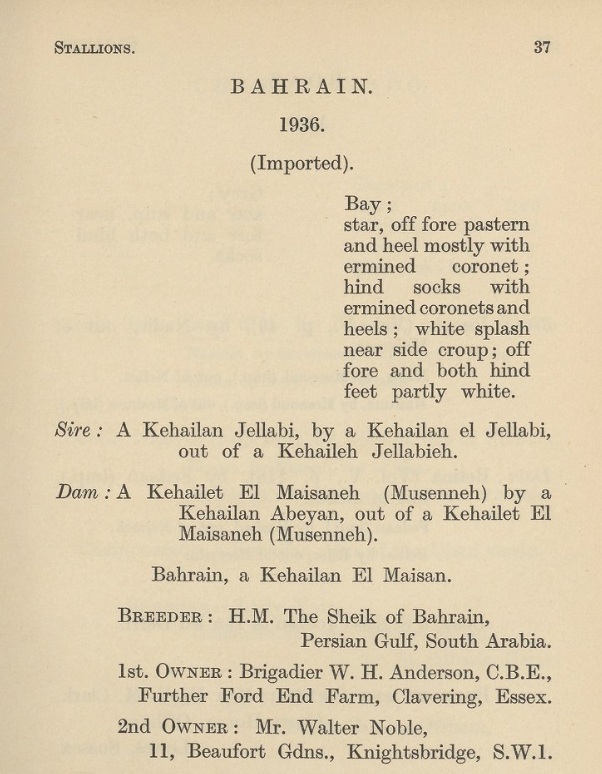
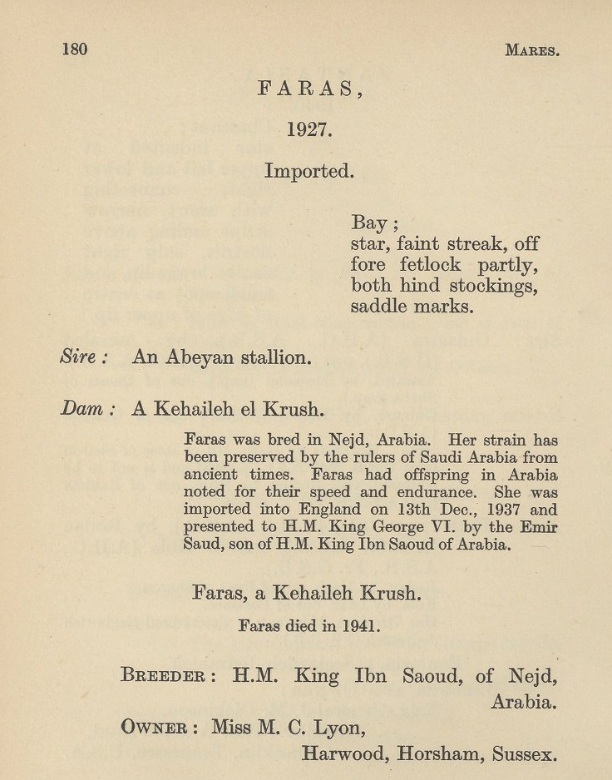
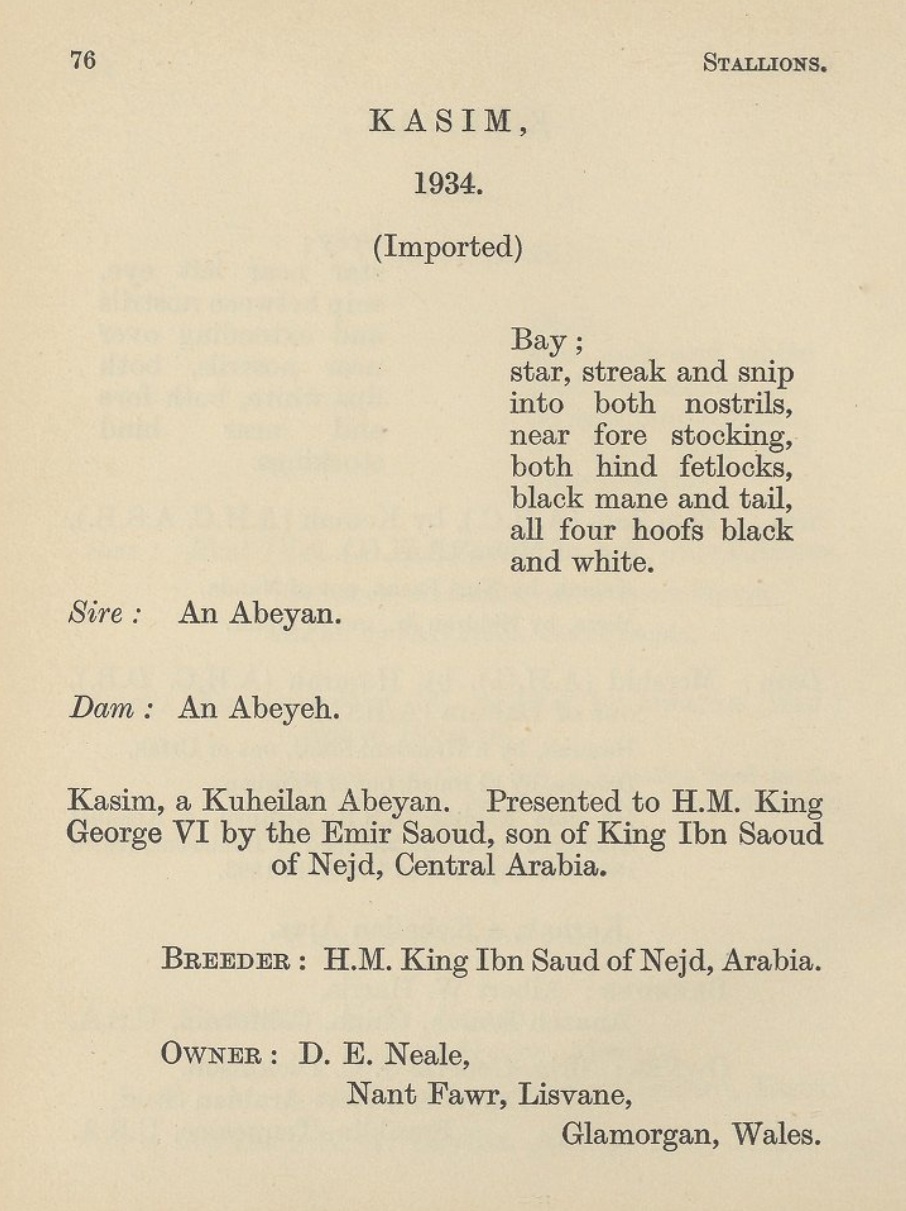
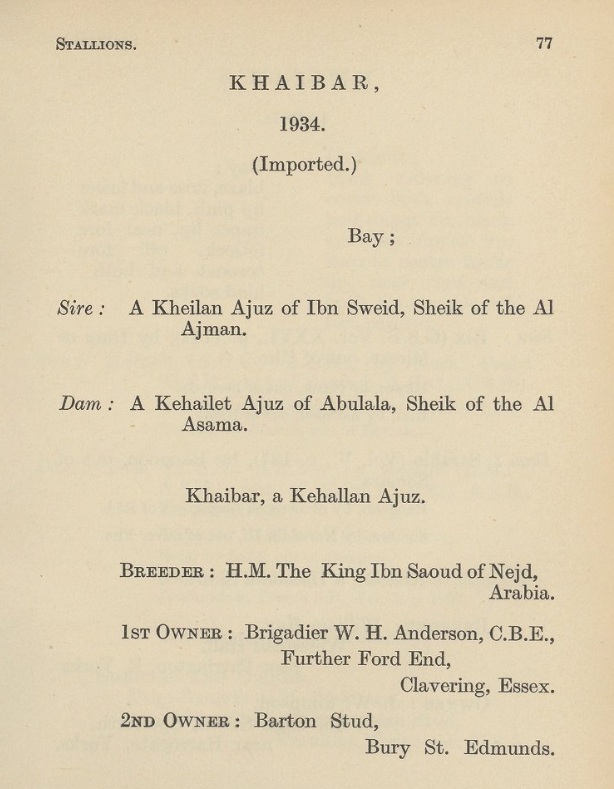
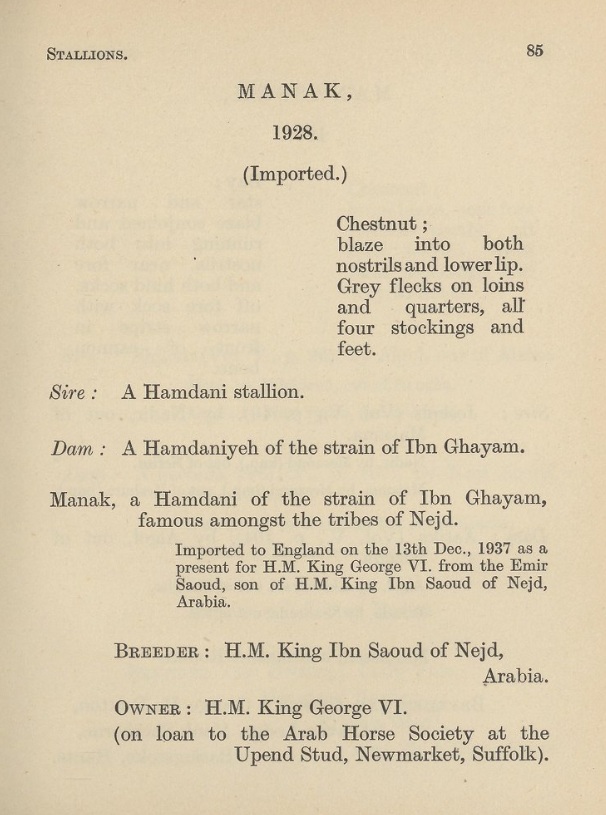
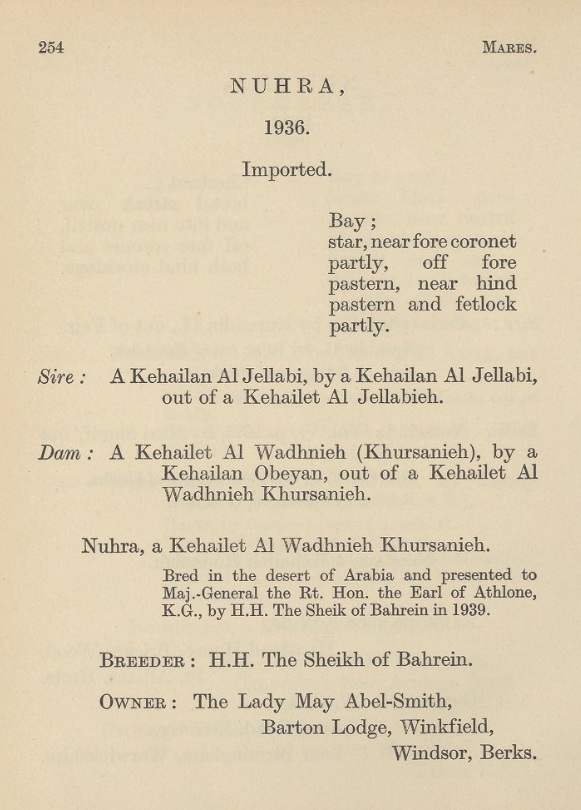
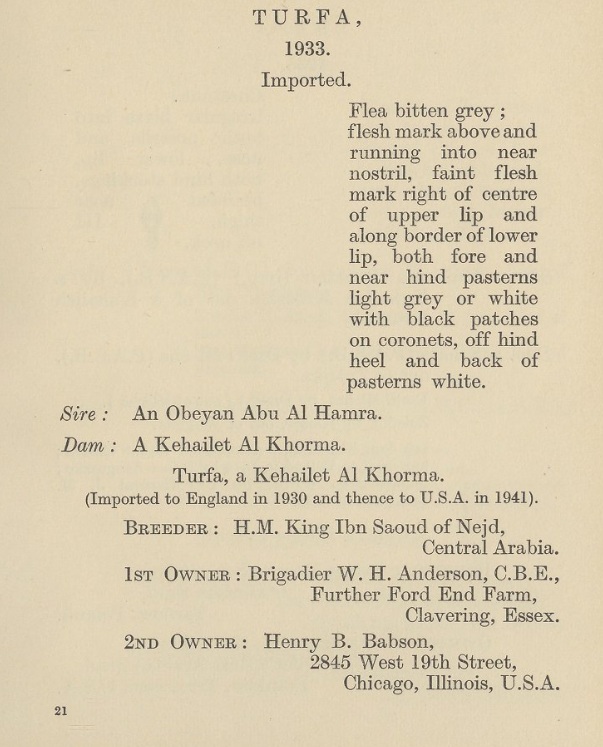
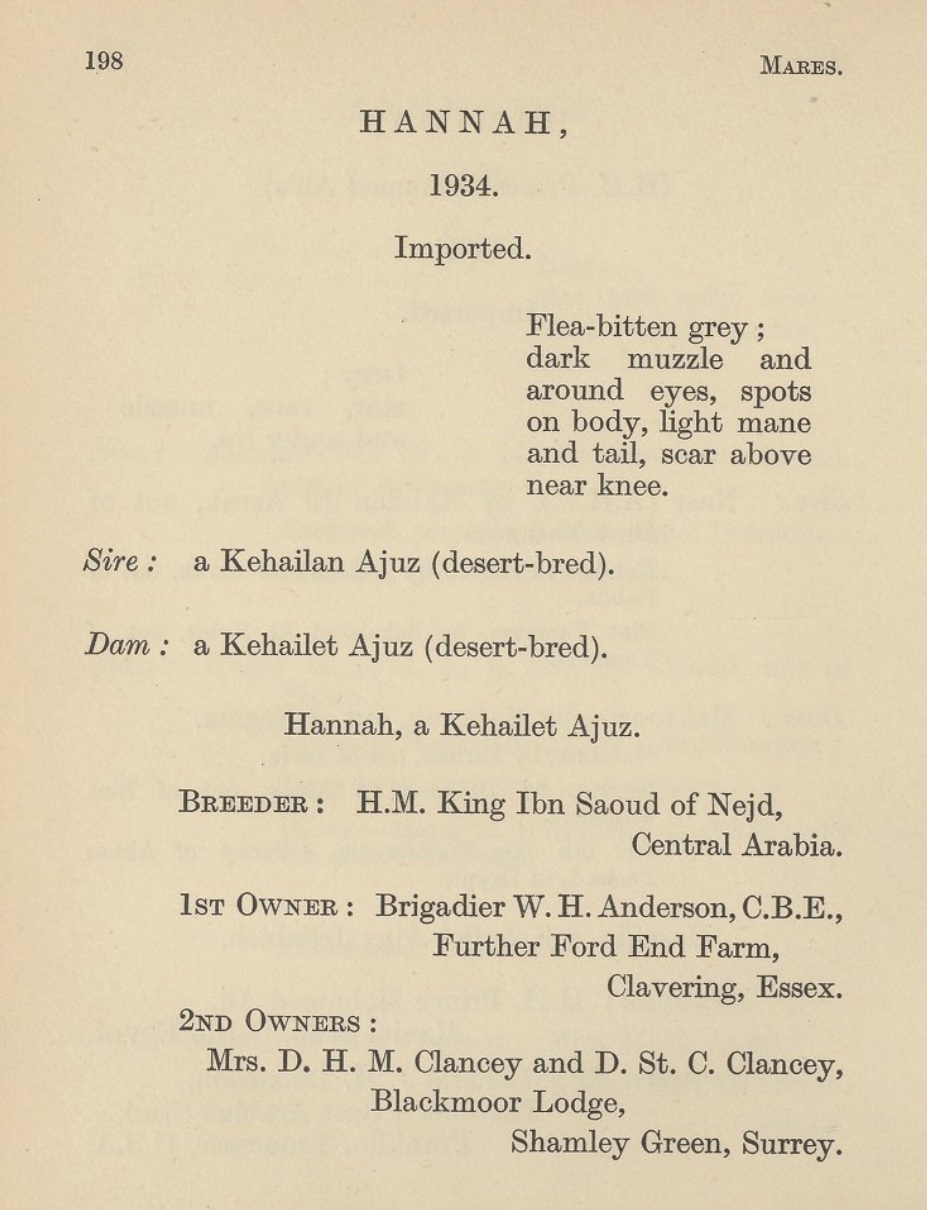
The eight are *Turfa, Hannah, Faras, Nuhra, Bahrain, Kasim, Khaibar and Manak. Four females and four males. Nuhra and Bahrain were from “H.H. the Sheik of Bahrain, Persian Gulf, South Arabia”. *Turfa, Hannah, Faras, Kasim, Khaibar and Manak were from “His Majesty King Ibn Saoud of Nejd, Arabia”.
Concerning *Turfa, as indicated before, Al Khorma is a town east of Mecca where a stud of the Saud family was located, not a strain or marbat.
Manak was a Sa’udi horse, not a Bahraini.
Interesting to see that Turfa’s first recorded owner in the UK is Brigadier Anderson, and that there is no connection to the British royal family in the stud book. I wonder what the source of the story that she was a gift for the then-Princess Elizabeth is.
That’s true. My bad. W.H. Anderson was a the Secretary General of the AHS, he must have served as prete-nom for the King. A bit like *Sunshine the Saudi in utero Harris import has the Saudi Consul in Damascus as the breeder/owner.
Two other stallions also have Anderson as a first owner: Bahrain and Khaibar. Note that *Turfa’s importation date seems like it’s a typo. She couldn’t have been born in 1933 and imported in 1930.
Kasim, Faras, *Turfa and Manak were all royal gifts from Crown Prince Saud ibn Abd Aziz, who alongside his younger brother Prince Muhammad, traveled to London to represent their father, King Abdulaziz at the coronation event of King George VI on May 12, 1937 at Westminster Abbey.
The Crown Prince departed Jeddah on April 16, 1937, aboard the British warship HMS Weston. He traveled through the Suez Canal to Cairo, then boarded an Egyptian steamship from Alexandria to Marseille. After spending a few days in Paris, he arrived at Victoria Station in London on May 7, 1937—five days before the coronation.
During his stay in the UK, Crown Prince Saud visited Lady Wentworth at her Crabbet Arabian Stud in Sussex.
Seems the horses arrived later in 1937, if the Illustrated London News’ December article on them was roughly contemporary with their arrival.
Al Khamsa had copies of the import documents for *Turfa for review in their production of the second Al Khamsa Arabians reference Book (1983) and that is where I saw the transfer of ownership to Henry Babson, signed by Brig, Gen. W.H. Anderson. Later when I was visiting the Babson Farm, I asked Homer Watson, long time manager of the Babson Farm, about Mr. Anderson and about *Turfa. He said that Mr. Anderson trained *Turfa for later riding for Queen Elizabeth who was then only a pre-teen. Homer said that *Turfa was in the care of Mr. Anderson along with some other horses of the Royal Family. Homer also added that he had written to Mr. Anderson about *Turfa’s training and Mr. Anderson said she was very smart, willing and a great mover but very sensitive to the reins. Also Homer mentioned that *Turfa’s skin was so thin that she was very, very sensitive to mosquito and other insect bites. Hence they took one of the stalls in the big cypress barn and screened it off for her to stay in on very hot humid days. This might explain things when I visited Joe Miller in Texas who was caretaker for Bob Cowling’s horses. Bob Cowling owned the double *Turfa mare Fa-Dlarah (Ibn Fadl x Bint Turfara). She had been shown successfully in halter in Texas but Mr. Miller said she had to be kept in on very hot humid days because she would get sores on her face from the biting flies and then could not be shown. When I saw her she was no longer being shown but she again had some sores on her face from that hot Texas summer of 1978. In 1979 we leased a grey stallion named DuFadl (Ibn Fadl x Dualah by Ibn Fadl) who was intensely *Turfa line bred. He did not have problems with insects however his skin was so fine that you could see all the veins on his legs in the summer!