The caption says Rose of Jericho and Dahna. Both mares were bred at the Crabbet Farm and then exported to Australia to live at the Quambi Springs Stud owned by Sir James Penn Boucaut. Rose of Jericho and Dahna, were both in 1891, and had foals on the ground as early as 1893. Dahna had 7 foals by Rafyk – 10 in total – whereas Rose of Jericho had at least 11 foals by Rafyk in her time in Australia – including Bedaween, the “Grand National Champion of Australia,” and his younger brothers, Zubeir and Suleiman – shown below. Zubeir, in particular, was a rather successful sire, breeding not only pure Arabian get but also horses suitable for the colonial life of Australians in the early 20th century. He was purchased by Mr. Warburton of Northern Australia. I was fortunate enough through the power of the internet to have a copy of his stud listing sent to me, which you can see below — It is from Zubeir that we derive the mystery of Minaret. Michael Bowling wrote a wonder article on this a while back, but to rehash: with any familiarity with the story of the Crabbet Stud, you’ll know that for some…
I’m always a little disappointed when people tell me that Arabians cannot jump, despite evidence to the contrary. As Kate likes to put it, they’re unique, and “they trust to the hand of God.” These mares are at the Arab Stud Farm in Needham Market, which is, of course, the farm of the Rev. F. F. Vidal. I’m not surprised that they’re jumping at his farm. Naomi herself was said to be quite a successful hunter in England before being imported overseas to Huntington’s farm – I know I’ve read it in a periodical source somewhere, but the easy example is the Allbreed info citing her as “An exceptional and widely-acclaimed field hunter known for clearing 7-foot fences carrying 196 lbs.” I wonder who these mares are. Michael Bowling suggests that they might be Shiboleth and the Anglo-Arab Trigonia.
Neither of these photos are new, but they are the largest, most complete versions I have seen, extracted from the 1898 reprint of Sarah Buckman-Linard’s book “My Horse; My Love.”
I am excited to introduce Kate McLachlan as an occasional blogger on Daughters of the Wind. Kate is a lecturer at the University of Cape Town, in South Africa, and holds a graduate degree in Ancient Philology from Oxford University. I am really looking forward to her contributions.
I am issuing this call as an adviser and a friend to the project ———————– Invitation YOU ARE INVITED to help shape the future of Arabian horse history as an Advisor to the Arabian Horse Archives Inc. — not to choose some aspects as important and sideline the rest, but to identify, preserve and protect archival materials relating to the world-wide history of the ancient and influential Arabian breed. The goal is to catalogue, and to facilitate the preservation of, such materials so that they are not only conserved but made accessible to students and researchers. We need to become visible in order to be noticed. Our first goal is to populate arabianarchives.org and illustrate the wide range of topics of interest, and the forms in which information exists. We ask that each of you provide a high-resolution scan (or photograph of a three-dimensional object) from your collections, representative of some aspect of Arabian horse history. Local or international, antique or mid-century modern — it’s all history. We need, in the current on-line environment, to develop an active social media presence. There is someone out there with the time and the skills to maintain Archives announcements on Facebook, Twitter, Instagram and other platforms.…
The high resolution photos of *Halool and *Koubishan, in the new Annotated Quest, courtesy of Jeanne Craver.
Extracted from ‘The Rasp – 1914’ — a picture of a younger Obeyran II (*Obeyran x Zitra) from Califnornian El Rancho de las Rosas, owned and bred (edit: well, maybe not) by the Tullys. I’d never seen a photo of Obeyran II before, and wanted to share this. This photo is also uploaded in the flickr I have set up, as well as photos that I find as I search (or as Google finally finishes reviewing books for me), and is updated as I go.
The Society for the Preservation of Desert Bred Salukis has a new webpage, www.desertbred.org
This was extracted from the Toronto Star Daily, circa August 29, 1929. The horse was identified as Aldebaran, and the markings (and bridle, though that is less conclusive) match up! This would be a photo of a 10 year old stallion, still relatively young and fit. He reminds me here of some of the other early asil horses I’ve seen, actually – Ashgar and Joseph, both from the Crabbet farm, and a younger Ibn Mahruss. There is also this photo of Aldebaran, also found in the Toronto Star Daily archives, taken in October of 1929– You can see here the quality of his face, and the ill-fit of the cavesson, which mirrors the usual photo of Aldebar that we see – though, again, that is hardly conclusive, but it may be that the bridle was Aldebaran’s personal bridle, and that is why you can see how rigid the newer/younger leather is, and why the older/more supple leather of the noseband has dropped down his nose.
Many of you who read this page know Lyman Doyle. He is so many things at the same time: the owner of the Doyle Arabian Stud, which is the longest Al Khamsa program in existence with the same family, going back to 1949; the CEO of Doyle Pacific Industries, in Shanghai, China, and a former armored cavalry officer. I have asked Lyman to publish some of his research on Skowronek and early Polish Arabian and not so-Arabian horses on Daughters of the Wind. Lyman has rediscovered a series of primary documents in the central and eastern European languages, by main protagonists of the time. He will present the information and sources as is, and leave readers to draw their own conclusions. Lyman will blog here and add materials on the page: daughterofthewind.org/skowronek
The captions for this photo were: “Mahruos, Arabian Stallion of the Santa Anita Ranch-1914 California History Print” and “At the ranch near Pasadena, the horse belonged to Mrs. Anita Baldwin McClaughry, daughter of E. J. Baldwin (noted California pioneer). ” Mahruos is, of course, a misnomer for Ibn Mahruss, who was owned by Anita Baldwin around this time. The leg and facial markings match up with other known photos of the stallion, as well. For any who haven’t seen it – there is a 1916 Santa Anita Rancho and Anoakia Breeding Farm Private Catalogue available for viewing online, located here.
“One of these horses, Obeyran I, is of the few rescued from the fanatic love of the Bedouins, which came so near proving the destruction of the entire importation of Arab horses brought to Chicago for the World’s Fair. By special permission of the Sultan of Turkey, twenty-eight Arab thoroughbreds were sent here for exhibition, with the express understanding that at the close of the fair every one was to be returned to the desert, alive or dead. This because of the perfect breeding and rarity of the animals selected. The men who financed the exhibit became so involved that they could not pay the cost of the importation and exhibition of the horses, which were consequently seized for debt and were to be sold at auction. The Bedouins in charge of the horses, horrified at the thought of their passing into the hands of unbelievers, on the night previous to the auction entered the stables, cut the throats of five of the horses and burned nine others. Of the remaining fourteen, nearly all were sent to England. Obeyran I was one of three left in the United States, and he it was that bore the Princess Eulalia of Spain in…
Kate and I were looking at the 1898 reprint of Sarah Buckman-Linard’s book “My Horse; My Love,” which is available as a public domain book on Archive.org courtesy of the University of Toronto (so, no need to buy the very poorly scanned reprints that are available via retailers right now!) This is a photo of Shibboleth, said to be the sire of both Kars and Sherifa in the book. The photos within this book, and the information, were apparently courtesy of both the Rev. F. Furse Vidal and Lady Anne Blunt. This is the first I have ever heard of a named (and photographed) sire of Kars, and I have to admit that I’m thrown for a loop here. Any more verse members of the community have more information on him to offer as we dig for more? A thought, however – the door and what have you is quite similar to that of what we see in the background of the infamous El Emir photo. Not sure what to make of that, either. Edit: This is the daughter of Kars and Sherifa. A connection, but not the one cited. Still, neat to see a photo of her.
Posting the photo of Moth and her daughter Major Barbara that started Jeanne Craver’s long and fruitful relation with Davenport Arabians, as a book end to the photo of Faziza below. Thank you Jeanne.
This tiny head shot proved to be confounding for me when I originally first saw it in Our Dumb Animals, Volume 45 [x]. The article it was attached to, “The Arab Horse,” had been written by Spencer Borden, and I couldn’t for the life of me place who the horse was; nor did Borden deign to identify him for me. Published in April of 1913, it was contained in a large volume, and a little bit of digging found two articles written about this very tiny and grainy photo of an Arabian, who turned out to be *Obeyran. I figured the articles were worth a share, and can be seen below – with an attached photo and transcription of them for those who might not be able to see the photos:
… is this picture of Faziza (Fa Turf x Azyya by Kenur out of *Aziza), the half Saudi, half Egyptian Arabian mare exported by Krausnicks to W.G. Olms of Germany. The picture is from Foppe Klynstra book, “Nobility of the Desert”.
It just occurred to me, much to my surprise, that we are about to lose any lines to the great *Haleb in Al Khamsa horses. Follow the genealogy, as you look at his Al Khamsa progeny, here, while noting that anything from his daughter Saleefy does not actually trace to *Haleb, because of the mare switch in California. From his second daughter Meleky, all that’s left is my 5 year old Mayassa Al Arab, and the 23 year old Nuri Al Krush, which I am in the process of leasing. From his third and last eligible daughter Rhua, the line to *Haleb flows through Alcazar. Here all that’s left is: the handful Hamdani Simri horses, tail female Selma, through Koreish, most of them at the Detweilers in PA, with an older mare in Georgia (Jadah Selma) and another in the midwest (Faserras Star); the handful horses tracing to LD Rubic, most of them in PA (two with me, five or six with Monica Respet), the 27 year old Salil Ibn Iliad in South Carolina and his two daughters there with Pam Baker. Samiras Adlaya now in Arizona, who is rare in so many ways The stallion Le Coquin and his…
That’s the photo, courtesy of Jeanne Craver, being referenced in the discussion below.
I have been thinking a lot about the early South American Arabians, imported before things went sideways. I know a few years back some folks here were looking into potential old asil lines for the horses, and I think it was concluded that non are extent today save for the horses that descend from the mare *AIRE – which is tragic. Nevertheless, I have been able to find photos of some of these old horses, and while it does little in the way of preservation efforts, I think it would serve as a bittersweet reminder of what we have lost, and what we strive to preserve. AJMAN (Feysul x Ajramieh), when he was still at Crabbet Park
WINNERS OF THE ENDURANCE RIDE. 1st. Halcyon, Arabian mare, H. H. Reid, rider. (Note: she was technically 3/4 Arabian and 1/4 Thoroughbred) 3rd. Yaquis, Arabian stallion, Lieut. R. M. Parker. (asil) 4th. Rodan, Arabian stallion, ridden by K. Malcolm Grinnell. (asil) Halcyon’s win is somewhat remarkable. Per the article: “Halcyon cast a shoe about 2.30 o’clock in the morning. A smith was aroused from his bed at the next town and the mare was shod by the light of an automobile that came along.” The second place horse was a Morgan horse. Unsurprisingly enough, these photos and the article accompanying were found in The Vermonter: The State Magazine, Volumes 16-19, edited by Charles Spooner Forbes, Charles R. Cummings, published September 1913. Photos of the individual horses can be seen below: HALCYON (Hail x Heiress / Maidan) YAQUIS (Garaveen x *Nejdme) RODAN (Harb x Rose of Sharon) source
The level of detail in Lady Anne Blunt’s Journals on mares of the Kuhaylan Mimreh strain belonging to members of the Egyptian royal family makes it possible to reconstitute a family tree of that strain that actually looks rather different from the one in stud books and genealogical lists (Cf. Pearson). Going through references to mares of the Mimreh strain in the Journals is tedious, but I find the effort to be worth it in the end. The first reference to that family of horses occurs under the Journal entry of April 11, 1891, except that the strain is misspelt Kehileh en Nimr instead of Mimreh, the probable result of a hearing error, as I wrote here. Lastly the Kehileh en Nimr of ibn Kayshish, a dark bay or brown mare with blaze. Age 12 years. Her name Fereyha.” The second reference is much later, on March 10th 1907, shortly after Ahmed Pasha’s death, in the context of a visit with the stud managers. Lady Anne lists 5 mares from this strain: (7) Chestnut Ke. Mimre, beautiful head ‘Ghazala’ at end of nose. Sire? 7 years (7a) Chestnut Ke. Mim 5 1/2 — dam? — blaze (Sire Dahman) [Edouard note:…
Pienaar Du Plesssis shared this ‘new’ photo of the 1955 Tuwaissan stallion which Valerie Noli-Marais got from Bahrain. I think it comes from the book of Hasan bin Salih al-Ruway’i, but I am not sure. that’s because its Hasan in the picture.
The following excerpt, in French, followed by my translation to English, from the French government buying commission led by Madron and Denis, describes three stallions it examined at the encampment of Hatchem (Hakem) Ibn Mhayd, leader of the Fad’aan Bedouins, north of Raqqa, in May 1925. Their long, detailed report, is the French equivalent of Davenport’s Quest, but has more informed insights about the status of Arabian horse breeding in Syria and Northern Arabia: “We had come to this tribe so renowned for its horses, hoping to find compensation for our previous setbacks. But as the same causes produce the same effects, there too, as a result of the misdeeds of winter and the drought of spring, we were only able to see horses in a rather miserable state. The mares we were presented with had all the hallmark of [Arabian] type, sufficient scope and even a strong bone structure, but many suffered from physical blemishes or conformation defects. After these, we were shown three grey horses. The first (below), which displayed the characters of the Obeyan family fairly well, stood out, with prominent withers, a good topline, a beautiful shoulder and good bone in his forelegs; but his hip…
Bev Davison’s stallion Subanet Jabbar SDA (Summer Sonnet SDA x Bint Bint Subani by Ibn Saafaddan), an 11 year old Saqlawi Jadran tracing to Ghazieh of Abbas Pasha, is a picture. Look at the jaw, the arch of the neck, the base of the neck, and the shoulder. Also, his splendid action, which shows in other pictures. Ginger was bred to him several times, so I really hope she takes. Bev Davison photo.
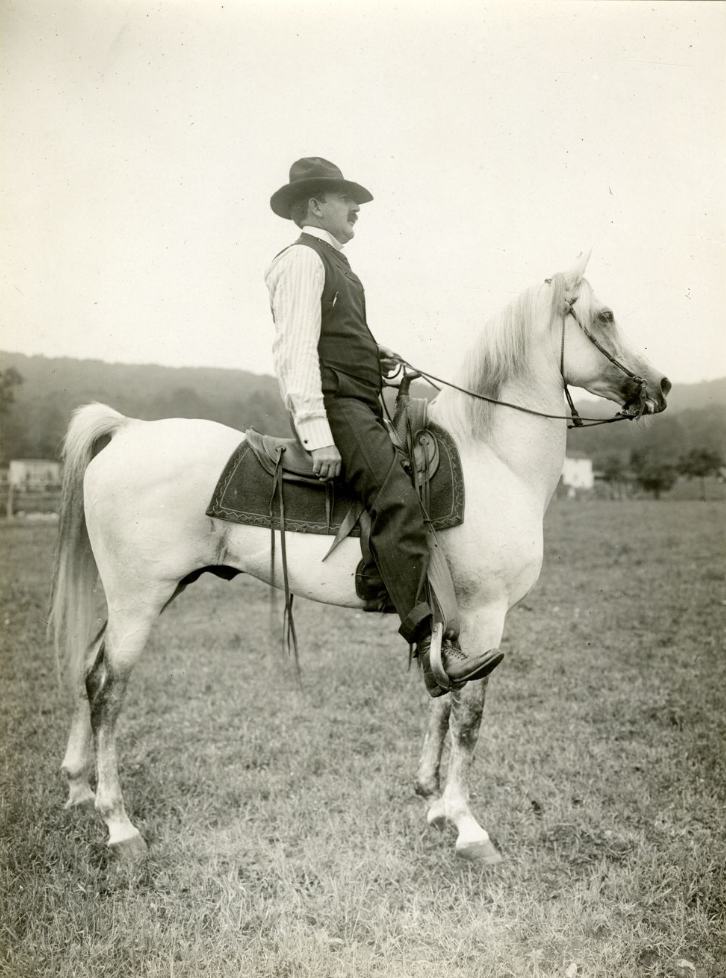
I was patiently waiting for a larger digital copy of this photo, which has just been sent to me by Heritage Auctions to be shared. The photo is of [Left] Buffolo Bill Cody aboard *Muson with [Right] Said Abdallah aboard *Wadduda. It very clearly evokes the grainy image from the Annotated Quest that I have always seen labeled something along the lines of “Wild East meets the Wild West.”
The facebook page for “Dartmoor Pony Chronicles” has this ‘new’ photo of the desert-import Dwarka. I have never seen ears so short on a Arabian horse (they’re too short), and placed so far back (that’s good), but I am also pleasantly surprised at how fine the muzzle and the nostrils are, how deep the jowls are, and how soulful the eyes are. I confess I was always a little biased against this horse, even questioning his authenticity credentials, and this photo makes me better disposed towards him. In the other photo the length of his ears is more normal, so I wonder what happened there.
I will keep emphasizing the contribution of the Dandashi clan of Tall-Kalakh, Syria to high quality Arabian horse breeding in the Middle East and beyond, all the way to Europe and the US. Babolna’s Obajan, the sire of Ameen Rihani’s *Muha, the sire of W.R. Hearst’s *Bint Rajwa all came from their stables, as did several of the foundation stallions of Lebanese breeding. Below, young Dandashi horsemen on their horses in 1890, from the FB page “Syria Photographic Museum”. Note the quality of the horses.
I am cross-posting this here from another place that I had written this, and would love to pick everyone’s brains on their thoughts. Full disclosure: this was jumpstarted by reading Teymur’s posts here on DOTW and by reading and re-reading Michael Bowling’s three part series on Leopard and Linden Tree (…and perhaps by some personal spite re: the long-dead Randolph Huntington. I ended up not overly caring for his theories on breeding.) ~~~ ^ Source: The Illustrated Stock Doctor by J. Russell Manning, published 1890, pg 66.
Moira Walker just shared this Flickr stream. Many never seen before photos of US foundation stock, especially of Segario, *Nejdran, *Ibn Mahruss, *Shahwan and *Obeyran, others perhaps as well. Each photo deserves an article. Is that large photo of *Hamrah also new, towards the middle of the stream? Aaaahhh!
For those unfamiliar with the previous El Emir post, I direct you here. For those having already read the post, I am posting this on behalf of Kate McLachlan and at the request of Jenny Krieg.
Moira Walker found this “new” photo of *Astraled (Mesaoud x Queen of Sheba) in an article written by Spencer Borden in the Cavalry Journal, Volume 29, April-July-October 1920, and shared it on social media, where it’s been circulating. Here is a link to the article.
Last November I submitted a proposal for the inclusion in the Al Khamsa Roster of a number of Bahraini Arabian horses that had been exported from Bahrain, to the UK, South Africa, Egypt, Poland, and Germany. The proposal was masterfully presented by Joe Ferriss, with comparative pedigree charts and nice photos, and it passed its first vote at the Al Khamsa 2018 Convention in Texas. Hopefully, by this November, I will submit a proposal for the inclusion of the Syrian horses that have been exported to the West. This new blood is a much welcome addition to the existing authentic bloodlines.
A photo of the desert-bred stallion *Muson, imported to the US in 1906 by Homer Davenport, which I had not seen before. From the New Jersey Magazine, ca. 1907. Gleaned from Rehan Ud Din Baber’s beautiful facebook page.
The other day Pienaar Du Plessis shared with me this photo of his asil Bahraini stallion Tuwaisaan 406, taken at 27 years of age. Tuwaisaan, now dead, was a gift from the King of Bahrain to his family. He is part of the proposal I made for the inclusion of exported Bahraini horses into the Al Khamsa Roster in North America. Note the resemblance with Mauvy’s drawing on the front of his book, below.
If there was ever a Bible about the Arabian horse, it’s this book by French master breeder Robert Mauvy. Twenty eight years and a hundred cover to cover reads later, it still reads like the first time. It’s the only book I own three copies of, for fear of losing one.
This is a follow on to a previous message about the horses of the Hamidie Society, some of which survive in modern Arabian horse pedigrees (including *Nejdme, *Obeyran, *Mannaky, *Galfia, and the elusive *Pride). The same letter by J.R. Dolbony I discussed in a previous blog post about the stallion *Mannaky is also relevant to the mare *Nejdme. *Nejdme is registered as a Kuhaylah ‘Ajuz, by a Saqlawi Jadran. An article from that time, has the reverse, by a Kuhaylan ‘Ajuz, out of a Saqlawiyah Jadraniyah. I personally see the attribution of these two strains to *Nejdme as suspicious, for two reasons: First, these are the run-of-the-mill Arabian horse strains or “brands”. Just like tissue paper is generally associated with “Kleenex”, and photocopy machines with “Xerox”, Arabian horse strains in the late nineteenth century were readily associated with “Saqlawi Jadran” and “Kuhaylan Ajuz”. Second, and that’s personal speculation on my part, I believe the officers of the Hamidie Society were under some expectation to send to the Chicago World Fair horses representative of the five main strains of the Al Khamsa legend, a bit like a car maker would showcase a full array of car types at a car salon: SUVs,…
The new Annotated Quest features a re-edition of Charles Craver’s article “Horses of the White City”, the most comprehensive article to date on the history of the Hamidie importation of Arabian horses to the Chicago World Fair of 1893. The history of the Hamidie horses themselves and that of the people around them is still shrouded with mystery. One of those people is J.R. Dolbony, who was associated with the importation in some way or other (he hailed from the Dalbani Shi’a Muslim family of Baalbeck in Lebanon today). I have found his testimonies about the Hamidie horses very intriguing, and I believe they should be taken seriously. In a letter to Homer Davenport from 1909 now at the US National Archives, Dolbony made several claims: 1) that he raised the Hamidie import *Mannaky; 2) that both *Mannaky’s sire and dam were of the Ma’naqi strain (hence his name); 3) that both were owned by “Sage el Misrub”, and 4) that *Mannaky was bred by this same “Sage el Misrub”. I have just identified this “Sage el Misrub”. He was none other than Sagr al-Misrub (that ‘r’ at the end of his first name must have been mistaken for an…
None of the three mares bred this year are in foal. Ginger came back in heat first and Bev bred her back to her stallion. Then Wadha turned not to be in foal to the Bahraini stallion of Jenny Lees, and that was a big disappointment after (or perhaps because of) all the work at the vet hospital, and she should have been back in heat but she is not. Not sure what’s going on there. And now Pippa has come back in heat, not in foal to Tamaam. Lyman Doyle is going to be try a breeding to Kashgar again (photo below, from Lyman). I wish that could work, because I like him a lot. If that does not work, I asked Lyman if he could try Buckner (photo below, also from Lyman), who has had a foal before. Buckner is an out-cross of sorts within the Doyle herd, as he brings in two close crosses to Greggan, two rare crosses to Subani, that cross to Serg, and that rare tail male to Ibn Gulribbon. I really need to learn why mares are such infertile animals. Or it’s just mine.
This has been simmering for some time. Photos of saluki Amira Khalid El Taif fFrom Gail Goodman’s collection.
This article appeared in the Khamsat Magazine issue in tribute to Charles Craver. I first met Charles (and Jeanne) in December 2000, when I took the train from Chicago where I was studying. It was a memorable visit, and we spent hours talking in their kitchen and looking at horses and old documents. Upon my return, Charles told a person whose identity escapes me now that “I had liked a very different set of horses than the ones other visitors typically liked.” This was true for the most part, because in addition to perennial favorites Pirouette CF and Wisteria CF, several Davenport broodmares with straighter profiles, less classical heads, and less round, more sloped hindquarters had caught my eye, and I had commented favorably about them. They were built like tanks, with deep girths, broad rib cages and high withers. I cannot recall their names today, but all were very reminiscent of mares of desert-bred stock I had known and liked in Syria and Lebanon while growing up there in the 1980s. These Davenport mares were “diamonds in the rough”, and it’s that unadulterated, un-sculpted, pristine quality that attracted me to them. The overwhelming majority of desert-bred mares and mares…
Through Pienaar Du Plessis in South Africa come these photos of the asil 1994 Kuhaylan Mimrah stallion Kibriya Nishkur (Sidi Abu Khai x Sidi Mabruka by Raafek), a sire of endurance winners in this country, with an improbable nine crosses to Morafic, and two close crosses to the 1955 Bahraini stallion Tuwaisaan of Valerie Noli-Marais. This horse is a case study in the change a small infusion of desert blood can do to Egyptian lines. Notice the big flat bone, and the muscle neck, the high withers and muscular croup characteristic of the Bahraini horses and of the old Kuhaylan Mimrah line of Barakah from Manial stables. Most Egyptian horses with nine crosses to Morafic don’t look so masculine.
Together with Aleppo, Sanaa in Yemen and Fes in Morocco, my favorite ancient city. Then come Florence, Budapest, Rome, Paris, Vienna. Here the suq of Midhat Pasha. Photos from the Library of Congress.
Photo gleaned on an online discussion where Lyman Doyle was asking about feedback on his Tamaam’s straight profile. Call this creature whatever you want, a snake, a seahorse, a mutant, “living art”, but not an Arab horse. This has gone too far.
Ginger — with Bev Davison in Idaho — was bred to Bev’s stallion Subanet Jabbar SDA (photo below), a Saqlawi with a high percentage Crabbet and Abbas Pasha blood, with close crosses to personal favorites like the Doyle stallions Parnell and Subani, and the dark bay Babson stallion Saafaddan. That was close to three weeks ago. Time for a pregnancy check. Below: Saafaddan, with Walter Shimanski.
Wadha was bred last week to the Bahraini stallion Shuwaiman Al Rais (photo below), from the breeding of Jenny Lees in the UK. I am looking forward to this cold outcross, the first ever of a Bahraini horse to a mare of old Syria (i.e. Davenport) lines. I hope it works, because Wadha was still showing fluid in her uterus as of yesterday.
Today Rosemary Doyle bred for me the Managhi mare Daughter of the Pharaohs (aka “Pippa”), which I leased from DeWayne Brown, to the Doyle stallion Tamaam DE (photo below, by Carver DE out of Maloof Habiba), who of 100% old Crabbet lines. Fingers crossed for a healthy foal in 2019.
Finally, Jamr Al Arab (Vice Regent CF x Jadiba) who is now under saddle with Sue Moss riding. Last photo while collecting is by Darlene. He traces to *Wadduda, the war mare of the leader of the Fad’aan Bedouins, imported by Homer Davenport in 1906. (I like repeating these things).
And this Wadha Al Arab before a trip to the vet clinic for AI breeding. Top photo by Darlene.
This is Jadah BelloftheBall (“Belle”), a Kuhaylat al-‘Ajuz from the strain imported by Albert Harris through Amin Rihani to the USA from the Saudi Royal Stables in 1932.
This is my not-so-little Barakah Al Arab (Wadd Al Arab x Jadah BelloftheBalll), almost two years old, and a Kuhaylat al-‘Ajuz tracing to the mare *Nufoud (ca. 1925) of the royal stables of Saudi Arabia. It was hard to get a full body shot because she kept mobbing me.
This past weekend Jeanne Craver flew in and out to say goodbye before I leave for a new assignment in South Africa, and we went to see the horses, together with Jenny Krieg and Darlene Summers. This is my beautiful Ma’naqiyah Sbayliyah mare SS Shadows Aana. Any foals from her seem extremely unlikely at this juncture.
Through Yahya Al-Tahawi in Egypt comes this new picture of El Deree, the desert-bred race horse that became a senior stallion at the Egyptian Royal Stud in Inshass. This photo was never published in the West before.
That is a local “Shami” breed of cows from Southern and Western Syria. They have red coats and produce relatively little milk, that is dense and delicious. It has now all but disappeared, crossed with imported cattle from Europe and elsewhere.
This mare has a fast pace and carries herself with distinction and style. My ten year old girl remarked on this saying: “I like Belle because she walks so proudly”. She embodies the unique nobility of the breed. Also, she produces better than she is.